


A few times in the last month, consultants have told me they have no pipeline. They say it the way you would report a chronic medical result.
Their project delivery is strong, the current clients are happy, but behind the current work there is nothing - no list, no next conversation, no idea where next quarters revenue will come from.
I have been having this conversation for over twelve years, across more than two hundred consulting businesses, and it nearly always ends the same way. I ask where their last five clients actually came from. And the person with no pipeline starts listing names.
A former client who moved companies and brought them in. An introduction from someone they worked with years ago. A proposal that lost on timing and came back round. Someone who had been quietly reading their work for a year before getting in touch. Four names out of five, sometimes five out of five, and not a stranger among them.
The pipeline you were taught to want
The word pipeline comes with a picture attached. Strangers in at the top, stages in the middle, clients out of the bottom. Fill the funnel, work the stages, count the conversion. It is a machine, and the instruction that comes with it is always the same: feed the machine more strangers.
That picture was built for software companies with sales teams, where the economics run on volume and the product does not care who sells it. It works there.
For an independent consultant it fails quietly, because every way of feeding the machine is something you rent.
Your referral partners dry up because they are struggling themselves
The ads stop the day you stop paying.
The cold list decays while you are still paying for it.
The marketplace takes its cut on every invoice and owns the client relationship
The algorithm changes its mind about your content and reach nosedives
I wrote about this arrangement at length in Stop Renting Your Pipeline, but the short version is: none of it is yours, and very little of your actual work has ever come from it.
Which is worth checking, rather than taking my word for it.
Run the check
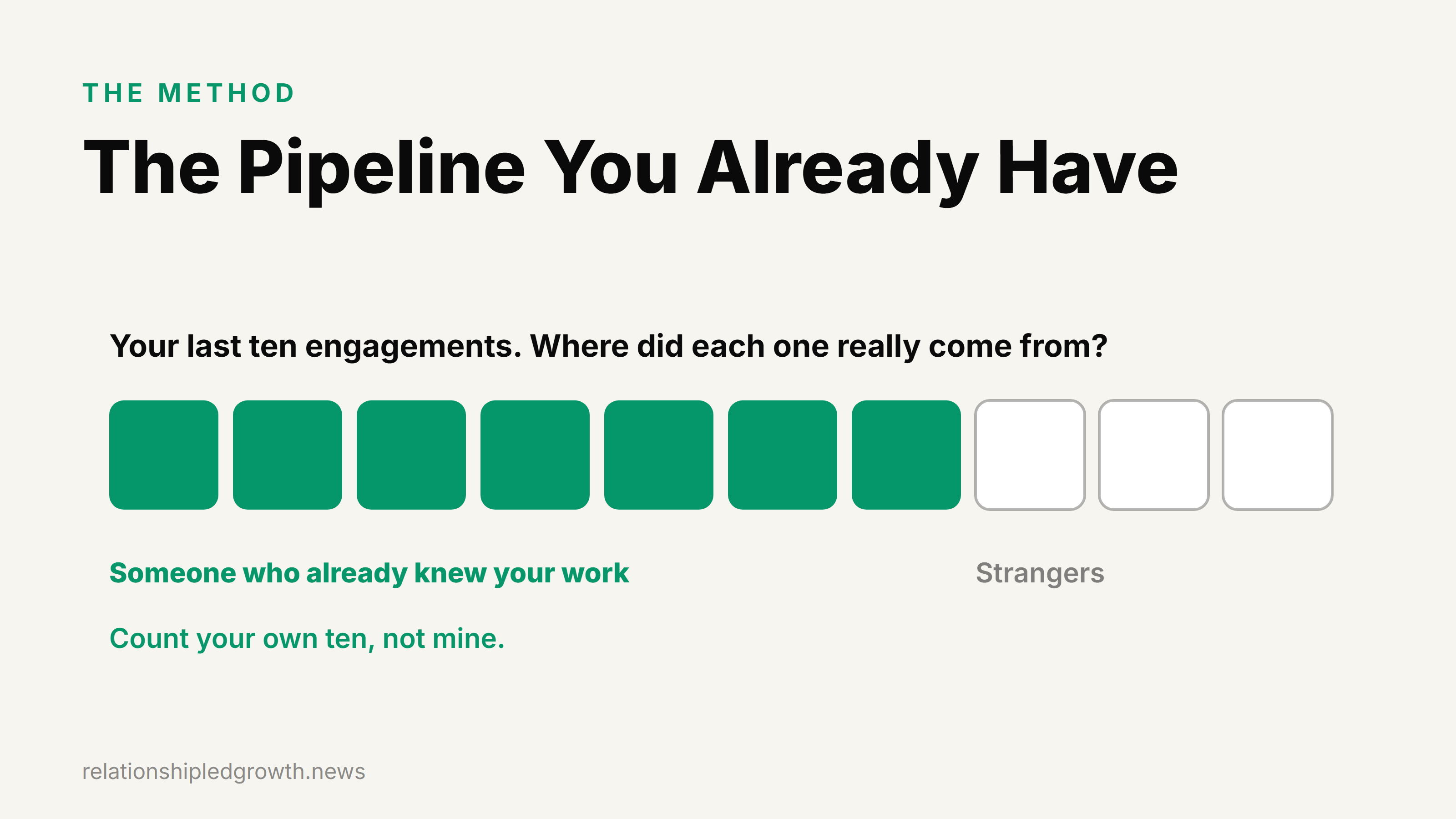
Write down your last ten engagements. For each one, trace it back to its actual first cause. Not the channel you would name at a networking event. The true origin: the person, the meeting, the old relationship the work really started with.
I am not going to hand you a percentage for what you will find, because your own list is the only number that should persuade you. But I will tell you what almost everyone finds: most of the list, usually nearly all of it, traces back to someone who already knew their work. A past client. A colleague from a former life. Somebody they helped once, unpaid, four years ago.
The standard model files these under "referrals and word of mouth", which makes them sound like weather. Good luck that happens to you. That framing is the single most expensive idea in independent consulting, because it takes the thing your business actually runs on and declares it unmanageable.
It is not unmanageable. It is just unmanaged.
What a relationship-led pipeline actually is
Your pipeline is every person who already knows what your work is worth, the current state of your relationship with each of them, and a way of noticing which of them needs attention this week.
That is the entire concept. No funnel, no stranger acquisition, no machine to feed. It is made of four groups of people you already know:
Past clients. People who have paid you and seen the result. They can buy again, refer you, and, most valuably, change jobs. A client who moves companies is not a lost record. They are your reputation arriving at a new budget.
The near misses or even ‘Ghosts’. Every proposal that lost on timing or budget rather than on you. Every "call me in July" and "not this year". These conversations did not end, they paused, and almost nobody on earth is tracking when they come back to life. I wrote about what those sentences are worth in Your CRM Only Remembers Half The Relationship.
The introducers. The people who have connected you to work before, or offered to. They are not clients and never will be, which is why every client-shaped system ignores them, and why their goodwill quietly expires unthanked.
Peers and former colleagues. The people doing adjacent work who pass things sideways when they are conflicted, overbooked, or out of scope. Sideways referrals are the most underrated channel in professional services and they cost nothing but staying in touch.
Write those four lists and you are holding a massive, untapped future pipeline. For most established consultants I meet it comes to somewhere between fifty and a few hundred names, and the reaction on seeing it written down is nearly always the same: I had no idea it was this many people.
If you are already taking action and listing names in your head, then you should also subscribe because this is what the publication is about. Twice a week, getting you to thing and take action.

Your state is the pipeline
The funnel model does get one thing right: things have states, and the states matter. It just tracks the wrong ones.
Deal stages describe the last few weeks before money moves.
Relationship states describe everything before that, which is where the next engagement actually forms. And a relationship really only has three: warm, drifting, or cold.
The dangerous one is drifting, because it is invisible. No relationship announces that it is fading. It just goes quiet a little longer than its own natural rhythm, then a lot longer, and by the time you notice, the warmth you are remembering is two years out of date. I wrote about how to measure this precisely in Every Relationship Has Its Own Rhythm, but the beginner's version is one question: who matters to this business that I have not spoken to in longer than feels right?
Notice what has happened to the pipeline question. The funnel asks: who do I add? This asks: who is drifting that should not be? The first question sends you out to strangers. The second sends you back to your own history, where the work has been coming from all along.
What working it means
Working a funnel means campaigns, sequences and volume. Working a relationship-led pipeline means something almost embarrassingly smaller: about a few hours a week, spent deliberately.
The manual version needs a spreadsheet, your calendar, and your sent folder. One row per person who matters. When you last spoke. What their normal rhythm is. What they last told you that you should not forget. Then a weekly pass: scan the list, pick the three people who most need attention, and show up with something specific and non-commercial. Reference the thing they actually said. Ask for nothing.
That is genuinely the whole engine, and the next post in this series [next week] builds it step by step with you [including the tools]:
the spreadsheet itself,
the first audit of your network,
your first reactivation of the people who have gone quiet,
and the weekly rhythm that keeps it alive in under an hour.
What it is not
It is not networking events. Most of the people in your four lists you already know, and collecting more strangers is the funnel talking. It is not posting more. Visibility helps, but visibility is rented reach layered on top of a pipeline, not the pipeline.
Start from unread
The consultants who tell me they have no pipeline are nearly always wrong, and wrong in a hopeful direction. What they do not have is a funnel of strangers, and they were never going to win easily with one of those anyway.
What they have is years of relationships, recorded in a sent folder and a calendar nobody is reading as the asset it is. Past clients who would take their call today. Proposals that paused rather than died. Introducers whose last favour was never followed up.
You are not starting from zero. You are starting from unread. The rest of this series [to follow] is how to read it and activate it.
While you wait - The free field manual. 7 Playbooks To Build Your Pipeline is the complete method for predictable revenue without feast or famine. Get it free from the Nynch Growth Agent:

Read next: Stop Renting Your Pipeline, on why every channel you do not own compounds against you, and Every Relationship Has Its Own Rhythm, on measuring drift before it costs you.
I write twice a week for consultants and fractional executives who grow on relationships rather than volume. Subscribe and the next one lands in your inbox.