


There is a question I have started asking consultants that produces an uncomfortable silence more reliably than any other.
If every channel you currently get clients from disappeared tomorrow, how long would you have work?
Most people answer in months, and the honest ones answer in weeks. Which tells you something important about what they actually own.
The rent you are already paying
Rent is not a metaphor here. It is the accurate word for the arrangement.
The middleman's cut. If you take work through a bench firm or a marketplace, a share of everything you bill goes to whoever made the introduction. It is charged not once but on every invoice, for the life of the client, on work you deliver alone. The commonly quoted figures for this sit in a wide band and vary enormously by firm, so I would rather you check your own contract than take a number from me. Whatever yours is, apply it to three years of a good client and look at the total.
The algorithm. If your pipeline depends on posting, you are renting attention from a platform that changes the terms without telling you. Your reach halves one quarter and nobody sends a notice. You did not lose the audience. You lost the distribution, which was never yours.
The list. Bought data dies the day you stop paying for it. It also dies quietly while you are still paying. People change jobs, companies restructure, inboxes close, and the list does not know. That is why the campaign that worked in March feels broken by November.
The referral you did not cultivate. This one people miss because it feels free. A referral source you have not nurtured is not an asset, it is luck with a good story attached. When it stops, and it does stop, there is nothing to repair because there was never anything built.
Every one of these has the same shape. Somebody else owns the connection to the client, and you are paying, in cash or in dependency, for temporary access to it.
The asymmetry
Here is what makes rent different from cost, and why I think this is the most important commercial idea for an independent consultant.
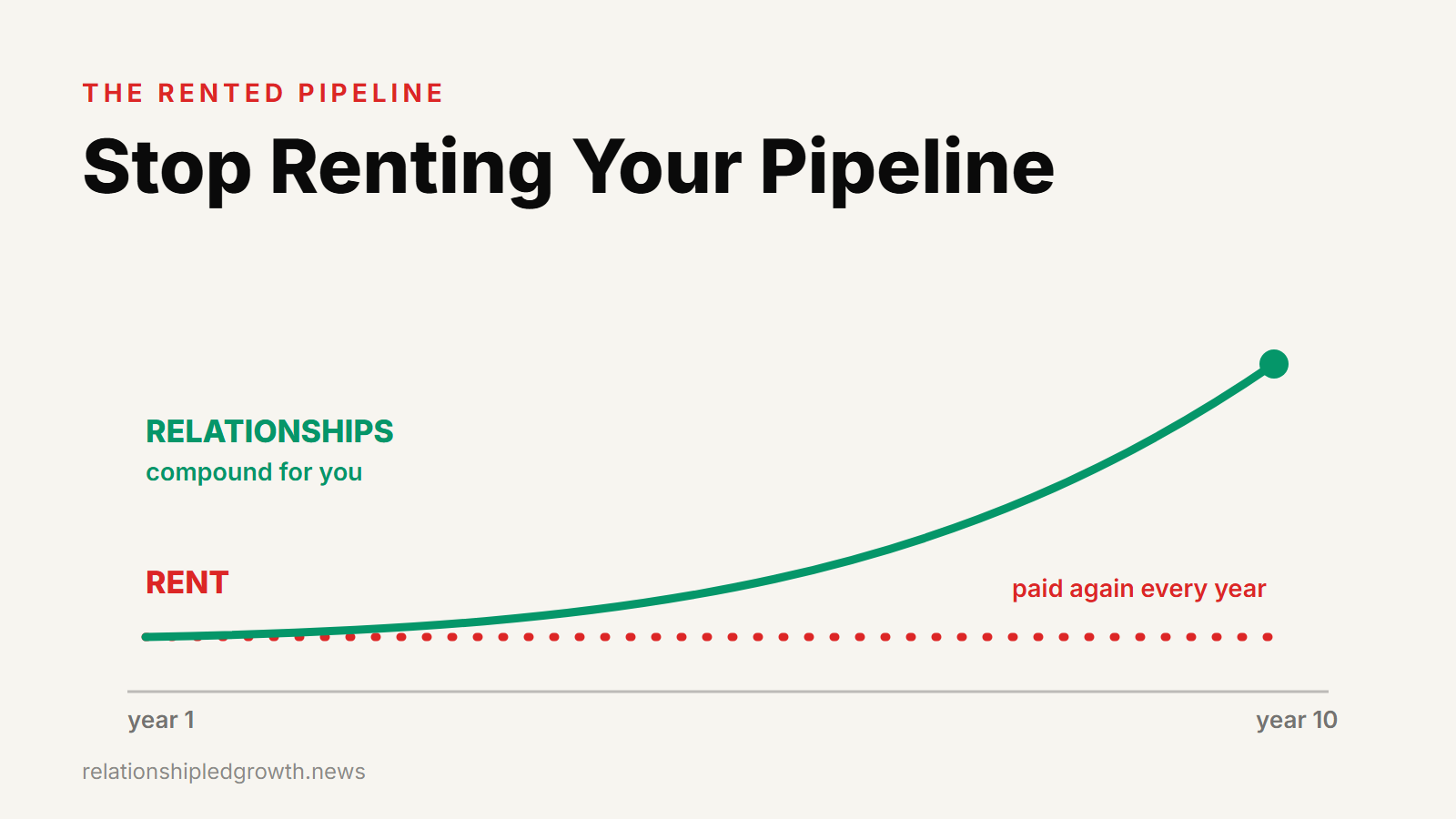
Rent compounds against you. Every year you stay in the arrangement, you pay again, and you are no closer to owning anything. Ten years of paying a middleman leaves you with exactly what you started with, which is nothing that belongs to you.
Relationships compound for you. Every year you keep one alive, it gets cheaper to maintain, more likely to refer, and more valuable when it moves. The client who leaves for a bigger company does not stop being your client. They become your client at a bigger company, and they take you with them, and that transfer costs you nothing because you already own it.
Same ten years. In one you have paid for a decade of access. In the other you have an asset that produces work while you sleep and cannot be repriced by anyone else's board meeting.
If this is landing, subscribe. Two essays a week for consultants who grow on relationships rather than volume.
The trap in the argument
Now, the honest part, because I think the crusade version of this is too clean.
Rented channels are not stupid. They are fast. A bench firm can put you in front of a client next month, and building an owned network takes years. If you have just gone independent and you have a mortgage, taking the rented channel is not weakness, it is arithmetic. I would take it too.
The mistake is not renting. The mistake is renting for a decade and never building the owned thing alongside it, because the rented channel keeps you just busy enough that the owned thing never feels urgent. That is the actual trap, and it is a comfort trap rather than an economic one.
So the question is not whether to use rented channels. It is what percentage of your revenue comes through channels you own, and whether that percentage went up or down this year.
Most consultants have never calculated it. Do it now, roughly. Take last year's revenue, split it into work that came through somebody else's channel and work that came through a relationship you own, and write down the ratio.
Then decide what you want that ratio to be in three years, and whether anything you are currently doing moves it.

What owning actually requires
Owning a pipeline is not a mindset. It is three specific things, and only the third is hard.
A record of who you know that survives your memory. Not a list of names. What they said, what they needed, what you promised, when they asked you to come back. Your memory holds maybe fifty of these well. You know several hundred people.
A rhythm you actually keep. Every relationship has a natural cadence, and once the silence stretches far past that cadence it stops being recoverable with a single message. Owning a network means noticing before that point, not after.
The discipline to work it when you are busy. This is the one that fails. Every consultant maintains their network beautifully when they are worried about revenue and abandons it completely when they are delivering. That cycle is the whole reason feast and famine exists, and it is not a character flaw, it is a scheduling failure that repeats because nothing external interrupts it.
The rented channel exists to solve exactly that failure. It works when you are busy because someone else is doing the work. That is precisely why it is so hard to leave, and why leaving requires building the thing that fires when you are not thinking about it.
Stop renting your pipeline. Own your relationships. It takes about three years and it is the only asset in this business that nobody can reprice.
The part that actually fails
Of the three requirements, only the third one kills people, and it is worth being precise about why.
You do not stop maintaining your network because you decided to. You stop because you are delivering, the work is in front of you, and nothing anywhere interrupts to say that a relationship worth six figures is thirty days from going cold. The rented channel keeps working during that period precisely because someone else is doing the remembering. That is the whole reason it is so hard to leave.
So owning your pipeline is not a discipline problem. It is a systems problem wearing a discipline costume, and you will lose that fight for as long as you are the only thing holding the record.
Nynch is the thing that fires when you are not thinking about it. It keeps the record of what everyone told you, tracks each relationship against its own rhythm, and puts a short list in front of you each morning with the reason attached. Ten minutes before the delivery work starts, on the days you would otherwise have done nothing.
That is what converts owning your relationships from an intention into an asset. Rent stops the day you stop paying. This compounds.
Talk to the founder. 30 minutes. On your real data. Not generic slides. Book a time.
The free field manual. 7 Playbooks To Build Your Pipeline is the complete method for predictable revenue without feast or famine. Get it free from the Nynch Growth Agent:

Read next: You Do Not Have a Pipeline Problem. You Have an Inventory Problem, on counting the work you already earned, and Your CRM Only Remembers Half The Relationship, on the record that owning actually requires.
I write twice a week for consultants and fractional executives who grow on relationships rather than volume. Subscribe and the next one lands in your inbox.