


Open any CRM ever built and look at what is actually stored.
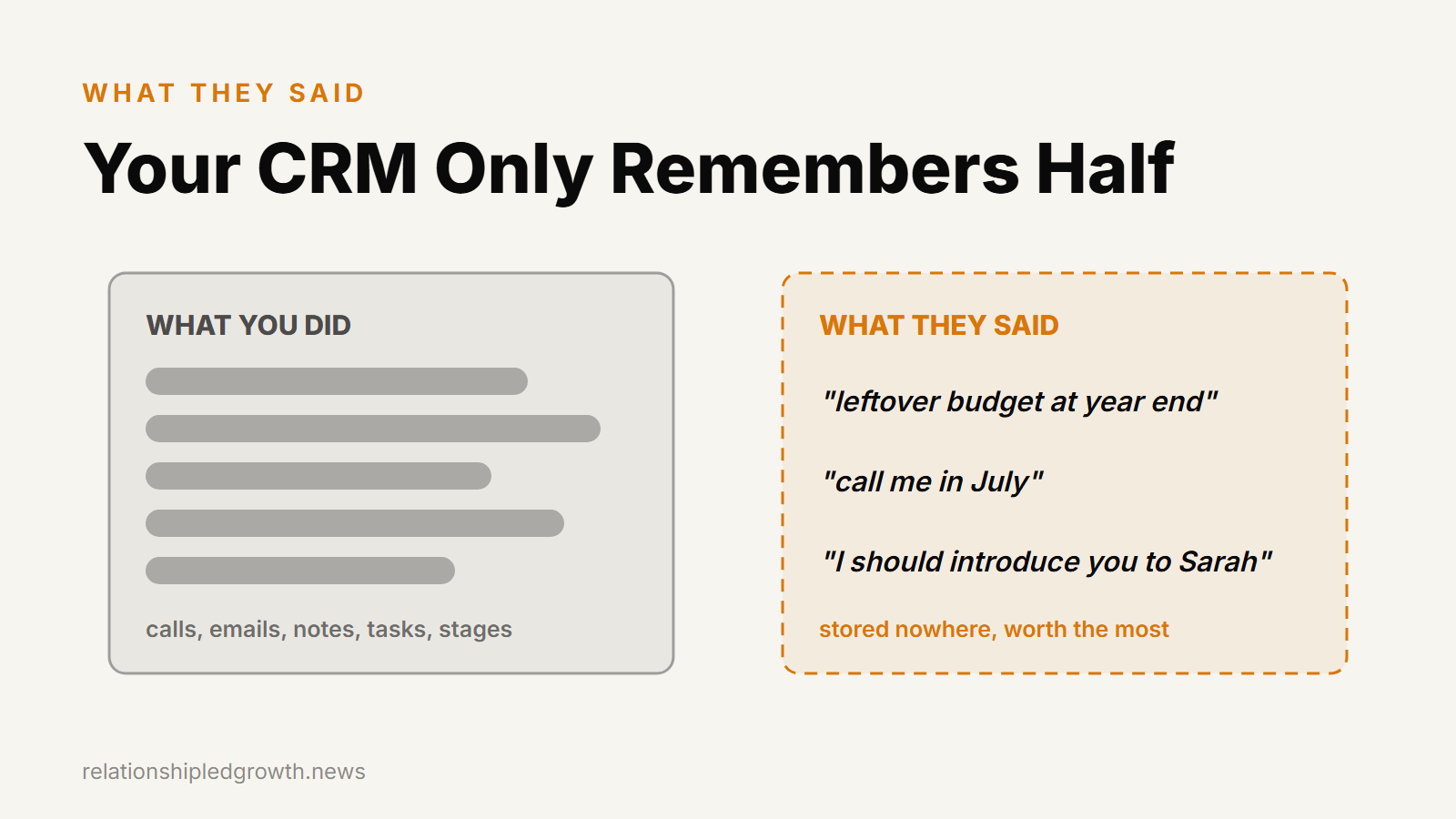
Calls you made. Emails you sent. Notes you wrote. Tasks you set yourself. Stages you moved things into.
Every single field is about you. It is a diary of your own activity, dressed up as a relationship record. And it is missing the half that the money is in.
Three sentences
Let me give you three real sentences of the kind that get said to consultants every week.
"We always seem to have leftover budget at year end."
Said by a client, in October, in passing, at the end of a call about something else. Not a request. Not an action item. Just a remark about how their organisation works.
"Call me in July."
Said by a prospect in February, ending a conversation that went well but was six months early. Perfectly clear instruction. Immediately forgotten by both of you.
"I should introduce you to Sarah at Acme."
Said over coffee, warmly, genuinely meant. The introduction never happens, not because anyone withdrew it, but because nobody wrote it down and there was no moment that forced it.
Those three sentences, in a normal consulting practice, are worth more than everything currently in your CRM. And not one of them is in it, because none of them fit the shape of anything it stores.
Why they vanish
They vanish because they arrive at the wrong time.
Every one of those sentences is a piece of information whose value is entirely determined by a date that has not arrived yet. The budget remark is worthless in October and valuable in October a year later. The callback date is worthless in February and decisive in late June. The referral offer is worth nothing at the coffee and everything at the point where you gently mention it again.
Human memory does not work this way. It is not a scheduler. It holds things by emotional weight and recency, not by future relevance, which means the single most useful category of business information you receive is the exact category you are worst at retaining.
And there is a volume problem underneath it. There is a limit to how many relationships one person can genuinely sustain, and it is far smaller than a contact list. You know far more people than you can hold. Most consultants are carrying several hundred working relationships on hardware built for a fraction of that, and the tier where clients and prospects actually live is already well past the point where you are remembering rather than knowing.
So the sentences are not lost through carelessness. They are lost because you are the only place they were stored and you were never capable of holding them.
If you have already thought of a sentence someone said to you that went nowhere, subscribe. This is what I write about, twice a week.
The asymmetry this creates
Now consider what it looks like from the other side, which is the part I find genuinely uncomfortable.
They remember. Not everything, but they remember the thing they told you. The client who mentioned the year-end budget knows they mentioned it. The prospect who said call me in July has that conversation filed somewhere. The person who offered the introduction knows they offered it.
So when nothing happens, it does not read as neutral. It reads as a small signal about how much attention they command. Nobody is offended by it. But something very slightly cools, and it cools on their side, where you cannot see it.
Meanwhile you have no idea any of this occurred, because from where you are sitting nothing happened at all. That is the worst property of this failure. It is entirely invisible to the person paying for it.

What a second memory changes
The fix is conceptually simple and operationally almost never done. The relationship needs two reliable memories instead of one fallible one.
Not a better note-taking habit. Notes are still your side. What is needed is a record of their side. What they said, in their words, with the date attached, and crucially with the date it becomes relevant attached too.
Once that exists, the behaviour changes on its own. October arrives and the budget remark comes back. Late June arrives and the callback surfaces. The introduction stays visible as an open thread until it closes, which is the only reason unfulfilled introductions ever get fulfilled.
None of that is clever. It is just holding the other half of the conversation, which no software any of us has used was ever designed to do.
The test
Here is a question worth sitting with.
Pick a client you have worked with for two years. Without checking anything, write down three specific things they have told you about their business that you have never acted on.
If you can do it easily, you are unusual. Most people manage one, and then realise the reason they can remember that one is that they happened to act on it, which is survivorship rather than memory.
Everything you cannot recall is still true. They still said it. It is still worth something. It is simply gone from the only place it was ever stored.
Your side of the relationship is well documented and worth very little. Their side is undocumented and worth a great deal. Every tool in this category has spent thirty years improving the wrong half.
Giving the relationship a second memory
I built Nynch because I could not find anything that stored the other half.
It reads what you have permitted, then keeps their side rather than yours. The budget remark from October, with the date. The callback request from February, surfaced in late June. The introduction someone offered at coffee, held open as an unfinished thread until it either happens or you decide it will not.
None of that is clever technology. It is a filing decision that thirty years of this software category got backwards, because every one of them was designed around recording the salesperson's activity for a manager to review, and you do not have a manager.
The test earlier in this piece is worth running before you look at any tool, including mine. Pick a two-year client, write down three things they have told you that you never acted on, and notice how hard it is.
Then ask what would have happened if something had been holding all three, and put them in front of you on the day each one mattered.
That is the entire product, and it is why I stopped trying to fix my follow-up habits and built a second memory instead.
Talk to the founder. 30 minutes. On your real data. Not generic slides. Book a time.
The free field manual. 7 Playbooks To Build Your Pipeline is the complete method for predictable revenue without feast or famine. Get it free from the Nynch Growth Agent:

Read next: Stop Renting Your Pipeline, on why the record is the asset, and You Do Not Have a Pipeline Problem. You Have an Inventory Problem, on what the forgotten half is worth in numbers.
I write twice a week for consultants and fractional executives who grow on relationships rather than volume. Subscribe and the next one lands in your inbox.