


You have had this exact experience. You message someone you used to know well, and the reply comes back polite, correct, and completely flat. Nothing went wrong. There was no argument. The relationship just quietly ended at some point and neither of you noticed when.
Most people file that under bad luck, or being busy, or the natural drift of a career. I want to argue something less comfortable and far more useful. That relationship did not fade at random. It went quiet for far longer than its own rhythm could carry, and the drift was visible the whole time to anyone who was measuring.
Every relationship has a rhythm
Not a schedule. A rhythm. The difference matters.
A schedule is what you intended. A rhythm is what actually happened. If you have spoken to someone roughly every four weeks for two years, the rhythm of that relationship is monthly, regardless of how close you feel to them or how you would describe the relationship to a third party.
You can measure it in about a minute. Pull the last twenty interactions with a contact, across email, calls, meetings, LinkedIn, whatever you use. Take the median gap between them. That number is the rhythm.
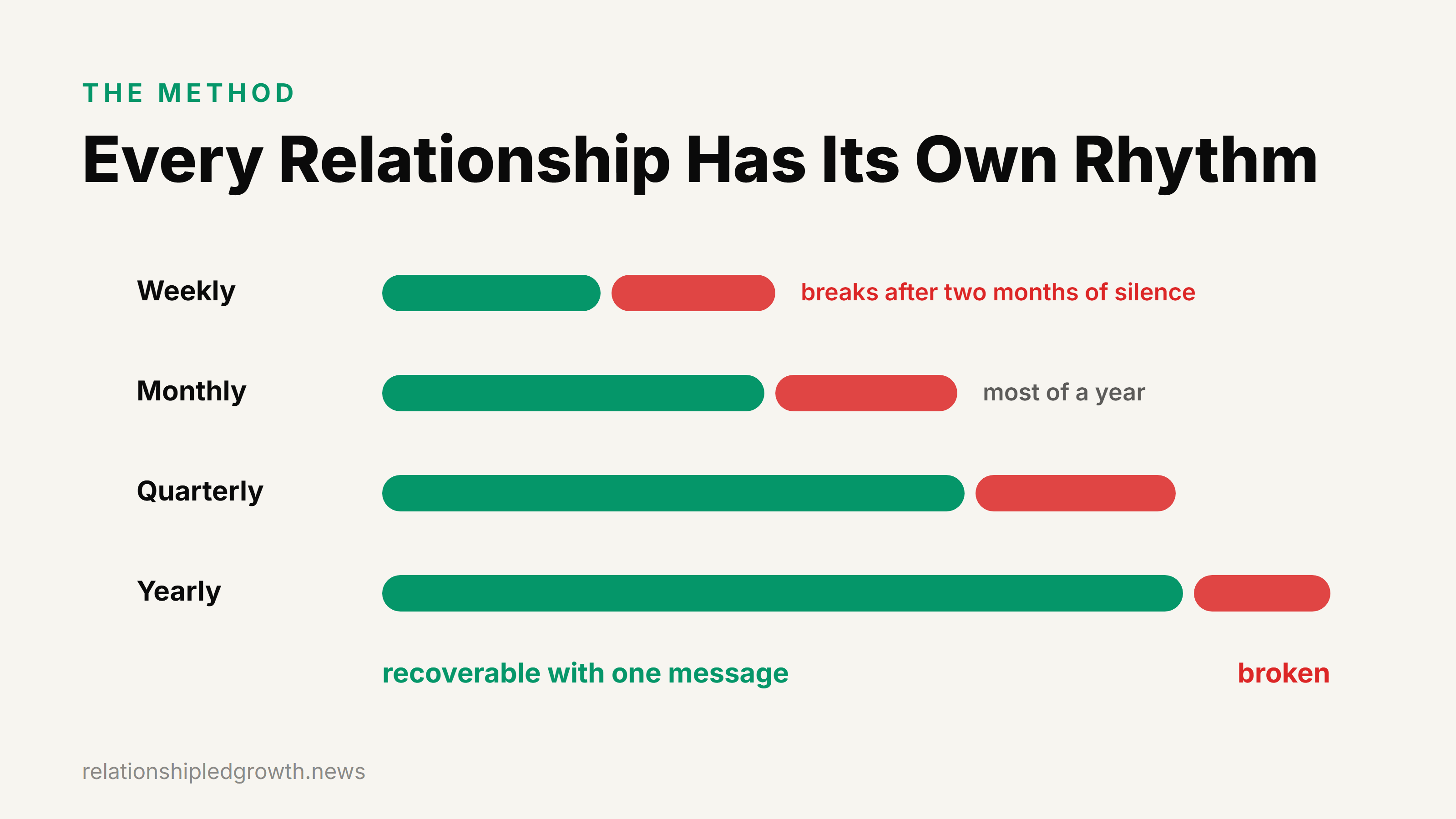
Most professional relationships land in one of four bands:
Weekly, a median gap of four to ten days. Active clients, current collaborators.
Monthly, twenty-one to forty-five days. Retainer clients, board members, key suppliers.
Quarterly, sixty to a hundred and twenty days. Past clients, advisers, industry peers.
Yearly, two hundred and fifty days or more. Conference contacts, distant former colleagues.
The rhythm is descriptive, never aspirational. If you have been speaking to an "important" contact once every nine months for three years, that relationship is yearly. Calling it monthly because you wish it were monthly is how people end up surprised.
The break comes when the silence dwarfs the rhythm
Here is the part that changes how you work.
While the current gap is close to the usual rhythm, a relationship is just dormant, and it recovers with a single good message. When the silence stretches to many times that rhythm, the relationship stops being dormant and starts being broken, and recovery takes two or three substantive exchanges before it feels alive again.
There is no magic multiplier in this, and you should be suspicious of anyone who sells you one. What I will defend, from two decades of watching it happen, is the shape. Decay runs relative to each relationship's own rhythm, not to the calendar. A weekly relationship is in trouble after a couple of months of silence. A monthly one is drifting by the time most of a year has passed. A quarterly one can survive well over a year, and a yearly one longer still.
Two things fall out of that, and both are counterintuitive.
Your loosest relationships are safer than you think. A quarterly contact is still recoverable eighteen months after you last spoke, provided it was genuinely quarterly for years beforehand. People burn real guilt on contacts that were never actually at risk.
Your closest relationships are far more fragile than you think. A weekly relationship breaks after two months of silence. Two months. That is one busy delivery phase. The gap feels small in absolute terms, which is exactly why nobody notices it happening. The relationships you would say you value most are the ones silence kills fastest.
If you are already listing names in your head, subscribe. Two essays a week for consultants who grow on relationships rather than volume.

Why this is invisible
The reason almost nobody catches this is that the threshold is relative and human memory is absolute.
Your brain stores "I spoke to Sarah fairly recently." It does not store "the gap with Sarah is now six times her natural rhythm and still growing." Nobody is doing that arithmetic across a hundred contacts, which means the drift operates entirely below the level anyone is watching.
So the failure is not a character flaw. It is a measurement problem. You cannot act on a threshold you cannot see, and no calendar, spreadsheet or reminder system is computing it for you.
What to do this week
Take your top twenty-five relationships. For each one, estimate the median gap from the last twenty interactions and write down the rhythm. Then compare it to the time since you last spoke.
Two lists come out of this. The ones whose silence has already stretched to many times their rhythm, and the ones drifting towards that line.
The second list is the valuable one. Those relationships are still cheap to save, and one specific, non-commercial message will do it. Reference something they actually did. Ask nothing. That is the whole move.
The first list needs a different posture. Reaching out with a pitch to someone you let go silent for a year reads exactly as it is, and they will feel it. Revive first, over two or three exchanges, and let commerce come later or not at all.
Most people who run this audit find an uncomfortable share of their network has already crossed the line. That list is confronting the first time. It is also the single most valuable list you have, because it is made entirely of people who already know you, already trust your work, and are currently being ignored by everyone including you.
Make it a habit, not an event
The audit is worth doing by hand once, so you feel it. For twenty-five relationships it is a morning, and it will teach you something about your own network that no dashboard ever will.
Then put a recurring hour in your calendar, monthly, to re-run it on the same twenty-five plus anyone new who matters. The arithmetic does not need to be precise. It needs to be regular, because the drift is continuous and your attention is not.
Nobody loses a relationship they were watching. They lose the ones they assumed were fine.
The free field manual. 7 Playbooks To Build Your Pipeline is the complete method for predictable revenue without feast or famine. Get it free from the Nynch Growth Agent:

Read next: You Do Not Have a Pipeline Problem. You Have an Inventory Problem, on what the crossed-the-line list is worth and how to work it, and Never Trust a Relationship Score That Cannot Explain Itself, on what to demand from any tool that claims to do this arithmetic for you.
I write twice a week for consultants and fractional executives who grow on relationships rather than volume. Subscribe and the next one lands in your inbox.