


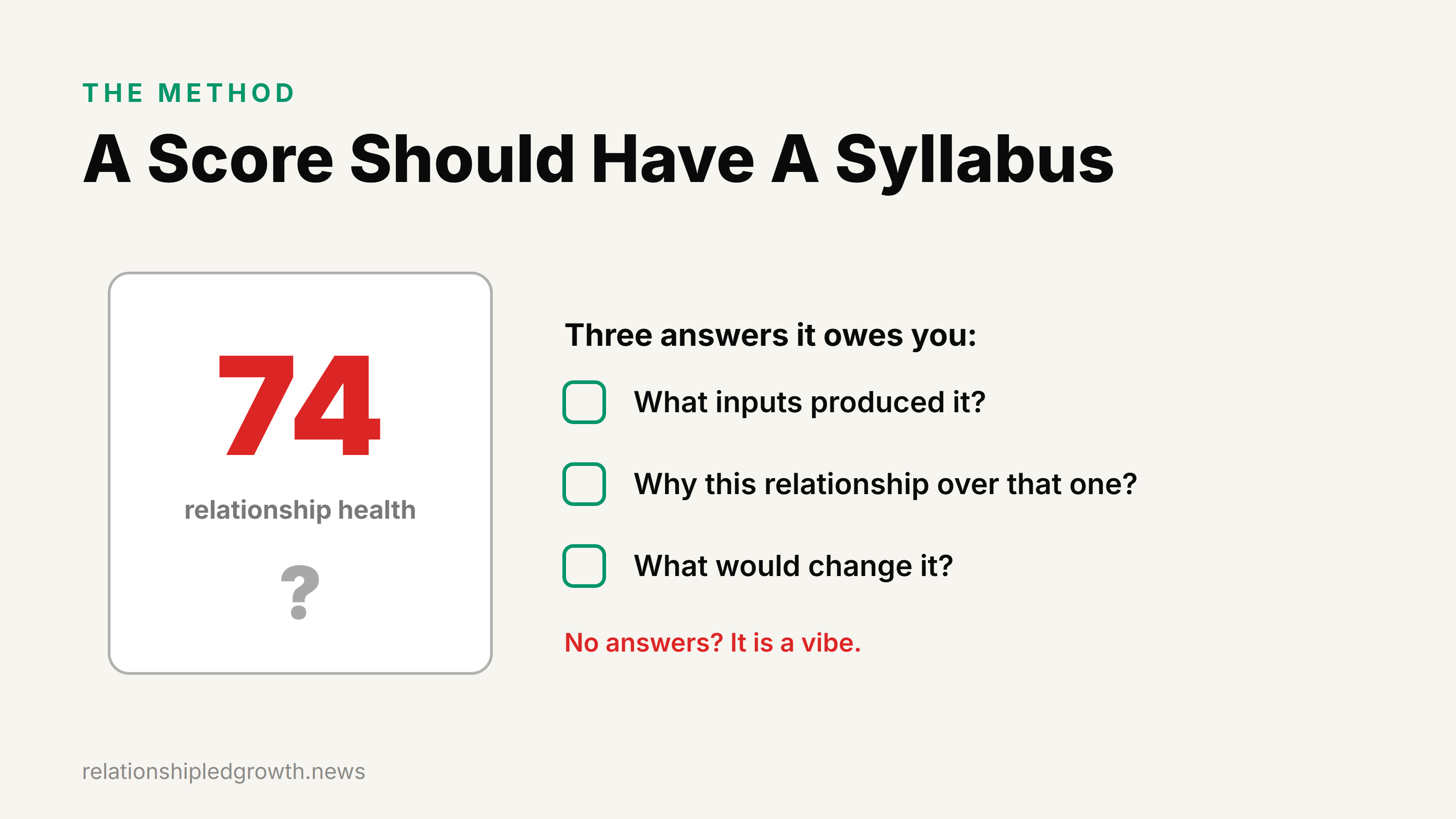
There is a number appearing in a lot of software at the moment. Relationship health. Engagement score. Warmth. Usually zero to a hundred, usually colour-coded, usually sitting on a contact card looking authoritative.
Ask where it comes from and the answer is almost always some version of "our algorithm". Which is a polite way of saying somebody picked weights that felt about right.
I am not against scoring relationships. I think it is necessary, because you cannot pay attention to four hundred people and something has to decide the order. What I object to is a number with no provenance, because a score you cannot interrogate is worse than no score at all. It replaces your judgement with someone's guess and gives it the authority of arithmetic.
So here is what I think a defensible one has to answer.
Question one: does it treat commitment as evidence or as sentiment?
Most scores are built from activity. Emails exchanged, meetings held, days since last contact. Volume and recency.
The problem is that activity and trust are only loosely related. You can exchange forty emails with someone who does not trust you at all. That is usually what a difficult project looks like.
The scores worth trusting put commitment at the centre rather than interaction volume. The blunt version: trust is not something you feel about a relationship. It is something you can observe, from whether stated commitments got kept.
Which gives you a genuinely measurable quantity. Of the things you said you would do for this person, what proportion did you actually do. Of the things they said they would do for you, what proportion happened.
I find that ratio far more diagnostic than any activity count, and it is uncomfortable to look at, which is usually a sign a metric is real. A relationship with high activity and a poor follow-through record is in worse shape than a quiet one where both sides have always delivered. No volume-based score will ever tell you that.
Question two: does it understand that decay has a shape?
The second thing most scores get wrong is time.
The naive approach is a threshold. Ninety days without contact, flag it. This is what most reminder systems do and it is almost useless, because ninety days is nothing for a relationship you speak to annually and a catastrophe for one you speak to weekly.
The better model treats decay as having a shape. Each interaction lifts the intensity of a relationship, and then that lift fades, at a rate set by the relationship's own established rhythm rather than a fixed calendar.
The practical difference is large. A rhythm-relative model tells you that your weekly contact is in trouble after two months and your annual contact is fine after eighteen. A fixed threshold tells you they are the same, which is wrong in both directions at once and produces alerts nobody trusts.
If you are enjoying having your dashboards insulted, subscribe. Two essays a week in this vein.

The honest caveats
Two things I want to be straightforward about, because this is exactly the territory where confident claims get made and should not be.
Any specific threshold is a design choice. Where exactly a system draws the line between drifting and broken is a judgement encoded in software, not a constant of nature. A good product owns that, and shows you the behaviour behind every alert so you can judge the call yourself.
No score is a measurement of trust itself. It is a model of the observable traces trust leaves behind: commitments kept, rhythms held, replies that come back. Anyone claiming more than that is overselling, and the difference matters, because the first is a defensible design choice and the second is a claim that would not survive contact with a statistician.
If a vendor cannot make caveats like these about their own score, that is your answer about how much thought went into it.
Turning the questions on myself
It would be cheap to write all this and not answer it for my own product, so here are the three answers for the score inside Nynch.
What produced the number. Interaction recency and frequency against the relationship's own established rhythm, the ratio of stated commitments to kept ones on both sides, and the tie strength implied by how the relationship has actually behaved over time. Not volume of email.
Why one relationship scores differently from another. The product will show you. Every score links back to the specific records that moved it, and where the evidence is too thin to stand behind a number, it says so rather than inventing one.
What would change it. Keeping a commitment you made. Reaching out before the rhythm breaks rather than after. Both are things you can actually do this week. If you would rather test that against your own network than take my word for it, that is a thirty-minute conversation.
What to actually ask, whoever you are buying from
You do not need to evaluate the mathematics. You need three answers.
What inputs produced this number. If the answer is proprietary, treat the number as decoration.
Why is this relationship scored differently from that one. A good system can point at the specific behaviour. A bad one restates the score in words.
What would change it. If nothing you could realistically do would move the number, it is not a management tool, it is a dashboard ornament.
The reason this matters is not intellectual tidiness. It is that you are going to act on these numbers. They will determine who you contact this week and who waits another month. If the ordering is arbitrary, you have automated your attention against a guess, and you will never find out, because the relationships that quietly failed will simply not be there.
A score should have a syllabus. Ask for it.
The free field manual. 7 Playbooks To Build Your Pipeline is the complete method for predictable revenue without feast or famine. Get it free from the Nynch Growth Agent:

Read next: Your CRM Only Remembers Half The Relationship, on the evidence a real score would need, and You Do Not Have a Pipeline Problem. You Have an Inventory Problem, on what is at stake when the ordering is wrong.
I write twice a week for consultants and fractional executives who grow on relationships rather than volume. Subscribe and the next one lands in your inbox.