


Most consultants who tell me they have a pipeline problem do not have one. They have an inventory problem. The work is already there. Nobody is counting it.
I want to give you the arithmetic, because the number is usually large enough to change what you do on Monday.
The calculation
Take four inputs.
Your network size. Not your LinkedIn follower count. The number of people who have actually worked with you, bought from you, referred you, or would take your call tomorrow. For most established consultants this sits somewhere between 200 and 800.
Your dormancy ratio. What proportion of those people you have not had a meaningful exchange with inside their natural rhythm. Do not guess high. Pick a number you could defend, and make the arithmetic yours. For the worked example below I will use 30 per cent as a placeholder.
Your win rate on warm reactivations. This is the one people get wrong, because they benchmark it against cold outreach. Reactivating someone who already knows your work converts far better than that. Pick a planning figure from your own history, and be deliberately cautious about it.
Your average engagement value. Whatever a typical piece of work is worth to you.
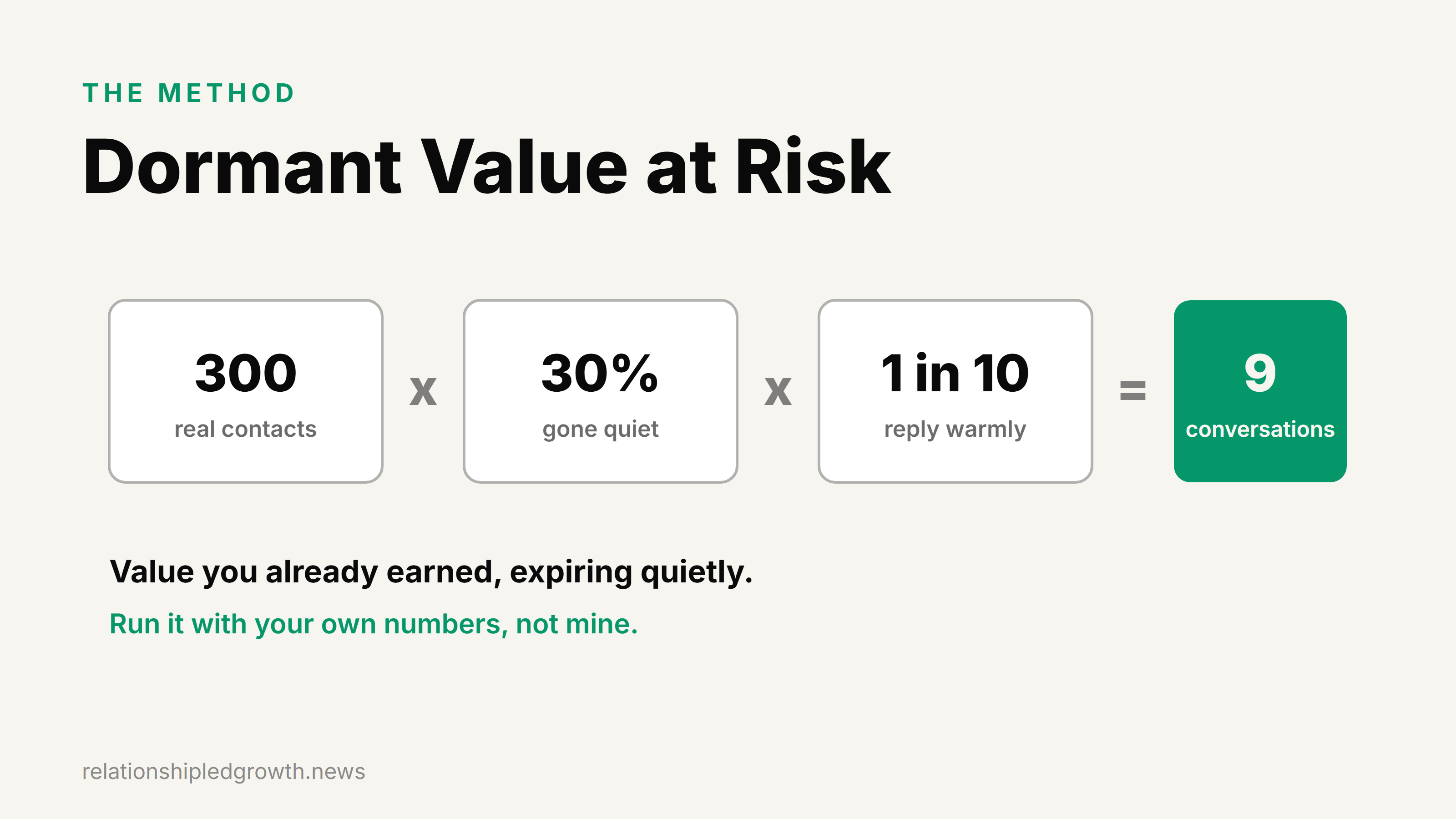
Now multiply. Three hundred contacts, thirty per cent dormant, gives ninety dormant relationships. Say a cautious one in ten of those turns back into a real conversation: nine conversations. At even a modest engagement value, the number lands in six figures. And every one of those inputs was yours, which is the point. Argue with the placeholder percentages all you like, then run it with your own.
That figure is your Dormant Value at Risk. It is not pipeline, because you have not created it. It is not forecast, because you are not working it. It is value you already built and are currently allowing to expire.
Why dormant beats cold, and why it beats warm too
There is a piece of network research that changed how I think about this entirely, and it is not the one everyone quotes.
The famous finding in network research is that weak ties beat strong ones for finding new opportunity, because your close circle mostly knows what you know. True, widely repeated, and not the finding that matters here.
The more useful finding is about dormant ties specifically. Levin, Walter and Murnighan ran a study published in 2011 called Dormant Ties: The Value of Reconnecting. They had executive MBA students go back to contacts they had lost touch with and consult them on a live work problem, then compared what came back against advice from their current active network.
The reconnected contacts did better. Their conclusion was that a dormant strong tie gives you all four benefits that normally split between categories. Trust and shared perspective, which you expect from a close relationship. Plus novelty and efficiency, which you normally only get from a distant one. They called it the best of both worlds, and the mechanism is obvious once you see it. They already know your work, so nothing needs re-establishing. And they have spent the intervening years somewhere you have not been, meeting people you do not know, developing problems you have not heard about.
One honest caveat, because it matters. That study measured the usefulness of the knowledge people got back, not revenue. Nobody has run it on consulting engagements. I think the read-across is sound, but I would rather you know it is a read-across.
A dormant contact is the only relationship type that is simultaneously high-trust and high-information. Your active network is high-trust and low-novelty, because you already know their news. Cold outreach is high-novelty and zero-trust. Dormant is the rare intersection, and it is the one nobody works, because it feels awkward.
If you are already running your own numbers in the margin, subscribe. Two essays a week, always something you can use.

Why nobody counts it
Three reasons, and they are all about feeling rather than economics.
It feels like admitting failure. Counting the relationships you let go cold means confronting the ones you dropped. Nobody enjoys building that list. So the list never gets built, and the value stays invisible.
Dormancy has no event. A lost engagement has a date. A relationship going cold has no moment, no notification, nothing in a calendar. It is a slow fade with no threshold you can feel, which means it never reaches the top of a to-do list.
The reactivation feels transactional. People assume reaching out after two years reads as "I need something." It does when you make it about you. It does not when you lead with something specific about them.
That third fear is the one that costs the most, because it is wrong in a way that is easy to fix. In my experience the reaction to a well-made reconnection is almost never irritation. It is relief. They had been meaning to get back in touch too, and you went first.
What to actually do
Do not build the full list. You will not finish it and the exercise will die.
Take twenty. Specifically, take the twenty people you would be genuinely pleased to hear from, who you have not spoken to in over a year. Not the twenty with the biggest budgets. The ones you liked.
For each, find one specific thing. Something they published, a role change, a company announcement, a project you both remember. Then send a short message that mentions that thing and asks for nothing at all. No meeting request. No "would love to catch up properly." No availability. Nothing.
The reason for the no-ask rule is that it converts better, and I know that sounds backwards. An ask forces them to make a decision about you. No ask lets them simply reply. Once they have replied, you are in a conversation, and conversations go where conversations go.
Twenty messages is about ninety minutes of work. Run it against your own numbers and decide whether ninety minutes has ever bought you more.
The part that matters more than the campaign
Doing this once is a nice quarter. The interesting question is why it needed doing.
Every one of those ninety dormant relationships crossed its threshold on a specific day, and on that day nothing happened. No alert, no flag, no line in a report. The economics of your business changed and the event was invisible.
That is the actual problem. Not that you neglect relationships, because everybody does when they are delivering. The problem is that neglect is the only business-critical process in a consulting practice that generates no signal at all. You would never let an invoice go ninety days without a system telling you. You let relationships go three years.
Run the twenty-message campaign this month. It works, and the number it produces will surprise you. Then put a date in your calendar to run the audit again next quarter, because the drift does not stop just because you noticed it once.
The list of ninety is not the finding. The fact that nobody told you is.
The free field manual. 7 Playbooks To Build Your Pipeline is the complete method for predictable revenue without feast or famine. Get it free from the Nynch Growth Agent:

Read next: Your CRM Only Remembers Half The Relationship, on why the reason to reach out is the half nobody stores, and Stop Renting Your Pipeline, on why this list is the asset your rented channels are hiding.
I write twice a week for consultants and fractional executives who grow on relationships rather than volume. Subscribe and the next one lands in your inbox.