


Something is happening to independent consultants that I do not think is being named properly, and it is going to be expensive for a lot of good people.
The short version: AI has made the solitary parts of your job dramatically better, and done nothing at all for the social parts. Both of those are true at once. Only the first one feels like progress.
The two halves of the job
Every consulting practice runs on two engines that have almost nothing in common.
The first is production. Research, analysis, structuring, writing, decks, models, proposals. It happens alone, at a screen, and it is measurable.
The second is relationship. Conversations that go nowhere in particular. A coffee with no agenda. Replying to something a former client wrote because it was interesting. Being available. It happens with people, it is not measurable, and almost none of it produces anything on the day it happens.
For most of the history of this profession, the two were forcibly balanced, because production was slow enough that you had to leave the desk. You went to the client site. You waited in the lobby. You picked up the phone because there was no other way to get the answer.
AI has broken that balance completely, and in one direction.
What actually changed
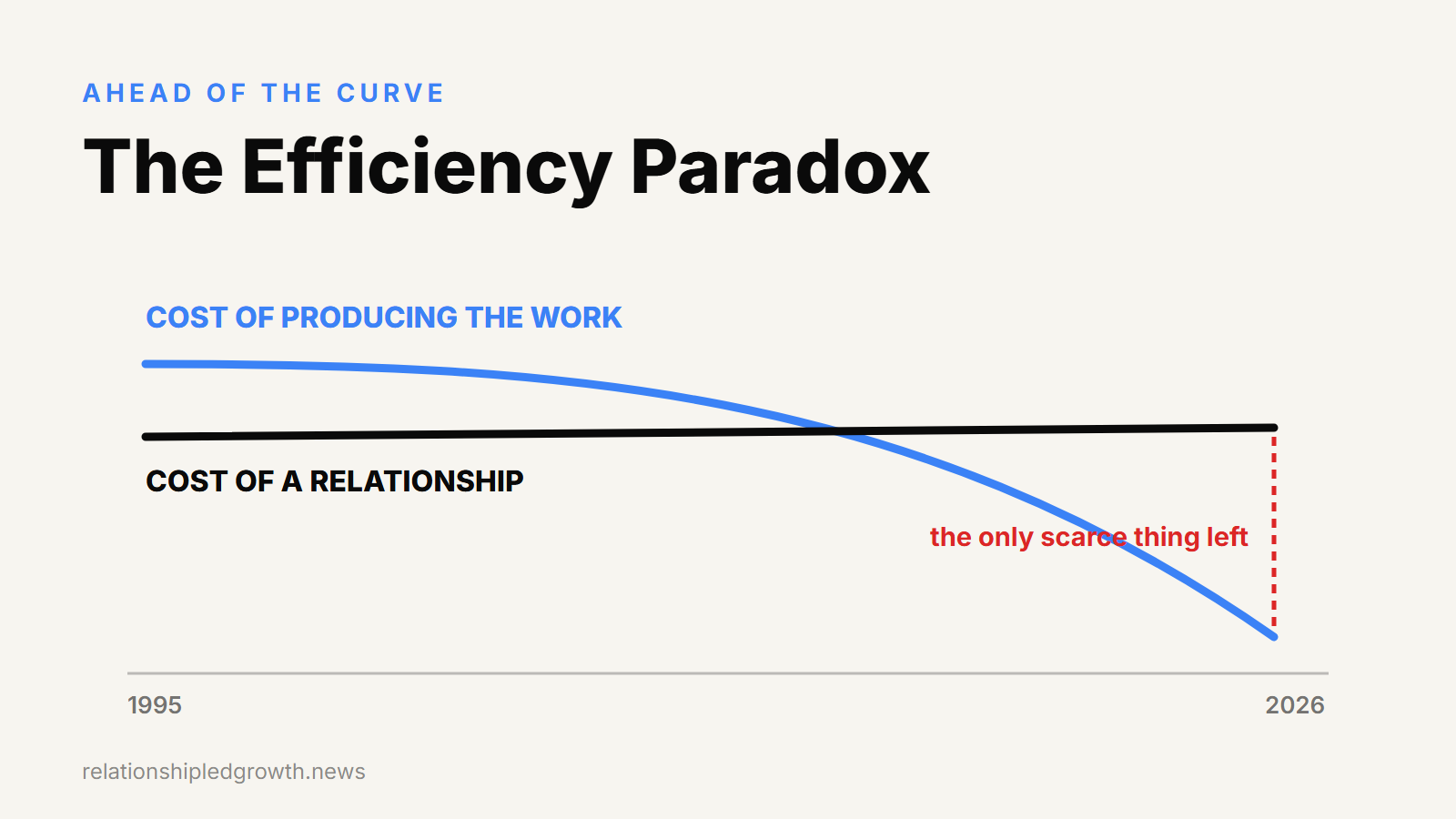
Production has collapsed in cost. The first-cut analysis that used to take a junior a week now takes an afternoon. The proposal that took two days takes two hours. That is real and I am not going to pretend otherwise.
The relationship half is exactly as expensive as it was in 1995. A conversation still takes forty minutes. Trust still takes years. Nothing about the technology has compressed that at all.
So the ratio has moved, quietly and without anyone deciding. You now spend a far higher proportion of your working life alone at a screen, being extremely productive, than you did three years ago. And because the productive part feels so good, and produces such visible output, it does not register as a problem.
The consequence takes about eighteen months to arrive. Your delivery has never been better. Your network has never been colder. The first shows up in this quarter's client satisfaction. The second shows up in the quarter where nothing comes in and you cannot work out why.
If that timeline made you count backwards, subscribe. Two essays a week on the half of the job the tools forgot.
The bit that should worry you more
Here is the argument that I think most people have not followed to its end.
If AI makes production abundant, production stops being worth much. That is what abundance does. The thing everyone can now do quickly is not the thing anyone pays a premium for.
Which means the scarce asset in professional services is no longer the ability to produce excellent work. It is being the person a buyer trusts enough to hand a problem to in the first place. Judgement, reputation, relationship. The parts that cannot be generated.
So the strategic picture is this. The only remaining scarce thing is trust, and the dominant new tool in the profession happens to make it easier than ever to avoid the activity that builds it.
That is the paradox, and it is genuinely nasty, because the behaviour that erodes your competitive position feels like productivity while you are doing it.

What I am not saying
I am not saying use less AI. That would be a stupid conclusion and I do not believe it.
Going backwards on production is not available. If you refuse to use the tools you simply become slower than everyone else at the thing that no longer differentiates you, which is the worst of both positions.
The answer is not less AI. It is pointing it at the other half of the job.
Pointing it at the other half
The half of your work that has never had any tooling is the relationship half, and it turns out to be the half where automation has the most to offer, because the failure mode there is not effort, it is memory.
You do not fail to follow up because you cannot be bothered. You fail because a client mentioned something in October, you were mid-delivery, and by the time it mattered the conversation had left your head entirely. Nothing in your working life was ever going to remind you, because you are the only system that held it and you are the wrong hardware for the job.
That is an information problem, and information problems are exactly what these tools are good at.
Used this way, AI does the detection and the preparation. Which relationship has gone past its rhythm. What this person actually said they needed. What you promised and did not do. What has changed at their company since you last spoke. Then you do the part that cannot be delegated, which is the conversation itself.
Used the other way, AI does the production and you do less of everything else. Same tools, opposite outcome.
The question to ask about any AI workflow you have adopted this year is simply which half it serves. If everything on the list is production, you are getting more efficient at the thing that is becoming commoditised while quietly starving the thing that is becoming scarce.
That is a fine strategy for this year. It is a poor one for the next five.
Pointing it at the other half in practice
This is the half I have spent the last two years building for, so I will be direct about it.
Nynch reads the relationship side of your working life: the emails, the meetings, the calls, the LinkedIn activity you have permitted it to see. Not to write for you, and not to send anything on your behalf. To hold what you cannot.
What that produces is the detection and preparation layer this essay argues for. Which relationships have drifted past their own rhythm. What this person actually said they needed, in their words, with the date. What you committed to and have not done. What has changed at their company since you last spoke. Then a short morning list of who to talk to, why now, and what to open with.
The conversation stays yours. It has to, because the conversation is the part that is becoming scarce and the part no tool can produce.
That is the whole design decision. Use AI for the remembering, which you are bad at and it is good at. Keep the connecting, which it cannot do and which is now the only thing you are really being paid for.
Talk to the founder. 30 minutes. On your real data. Not generic slides. Book a time.
The free field manual. 7 Playbooks To Build Your Pipeline is the complete method for predictable revenue without feast or famine. Get it free from the Nynch Growth Agent:

Read next: Stop Renting Your Pipeline, on owning the asset the tools cannot make, and You Do Not Have a Pipeline Problem. You Have an Inventory Problem, on what eighteen months of quiet actually costs.
I write twice a week for consultants and fractional executives who grow on relationships rather than volume. Subscribe and the next one lands in your inbox.