


Try this. Without looking anything up, write down in one sentence the problem you solve and who has it.
Now go and read your LinkedIn headline. Then the first paragraph of your website. Then the opening of the last proposal you sent. Then how you actually answered when someone asked at an event last month.
For most consultants those four are recognisably related and meaningfully different. Different problem emphasis, different buyer, sometimes a different business.
That is not sloppiness. It is a structural problem, and it has a cost that is easy to miss.
Where the drift comes from
Nothing in a consulting practice forces those four things to agree.
Your website was written in a burst of clarity two years ago. The proposal was written under time pressure for a specific client and inherited that client's language. The LinkedIn headline was optimised for a search term. The verbal answer is whatever version has been getting good reactions lately, which is genuinely the most current one and is written down nowhere.
Each was correct at the moment it was made. None of them were updated when the others changed, because there is no mechanism that would do that. So the practice slowly develops four adjacent positions and no canonical one.
Now add tooling on top. You have a note-taker, a drafting assistant, a proposal generator, something writing your posts. Every one of them is working from whatever fragment of context it happens to have. If the source is inconsistent, everything downstream inherits the inconsistency and multiplies it, at speed.
Which is why people complain that AI output sounds generic. Often it is not the model. It is that nobody ever gave it a specific thing to be consistent with.
What it actually costs
Referrals get vaguer. This is the expensive one. A referral only works if the person making it can describe you in a sentence. If your own description shifts, theirs will be a blurry average of everything they have heard, and a blurry referral converts far worse than a sharp one. You have made the person advocating for you sound uncertain.
Proposals start from scratch. Every one gets rebuilt because there is no canonical account of your services and pricing to inherit. That is hours, repeatedly, on work you have already done.
You get shortlisted for the wrong things. When the position drifts wide, you attract enquiries at the edges. Then you spend real time qualifying out, or worse, take the work and deliver something you are not especially good at.
Pricing softens. Harder to defend a premium for something the buyer cannot precisely name. Vagueness quietly becomes a discount.
If any of those four costs stung, subscribe. Two essays a week on running a practice that compounds.

The fix is a document, and it is boring
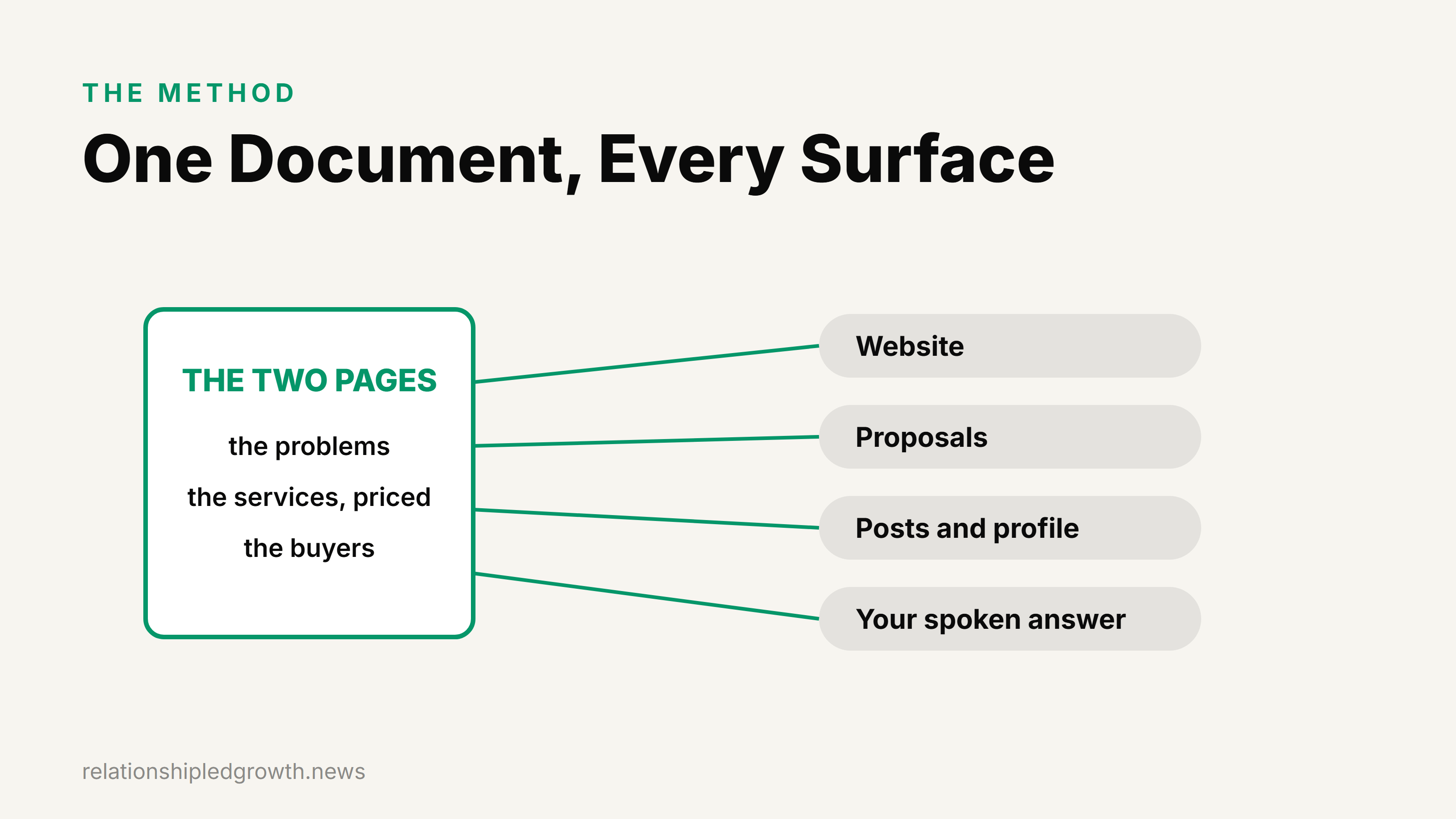
The remedy is not a rebrand or a positioning exercise with a facilitator. It is one document that everything else copies from, and it needs exactly three parts.
The problems. Not your services. The problems your buyers actually have, written in their words rather than yours. Four or five, no more. If you cannot write them in language a buyer would recognise, you do not have them yet.
The services. What you sell against each problem, with the shape of the engagement and the price band. Written down, including the number, because a price you have to reinvent per proposal is a price you will discount under pressure.
The buyers. Who has these problems, their role, what triggers them to act. The trigger matters more than the demographic. "CFO" is not a buyer. "CFO in the first ninety days of a role, inheriting a reporting process they did not build" is a buyer.
Three sections. Two pages. Most people can draft it in an afternoon and then spend a fortnight arguing with themselves about the problems, which is the part that is actually the work.
Then the rule
The document is worthless without one discipline, which is where most people fail.
Everything you produce copies from it rather than reinventing. Website, proposals, posts, your verbal answer, and every prompt you give a tool. When the position genuinely changes, you change the document first and then push the change outward.
That direction is the whole point. Right now your position updates in whatever surface you happened to be writing in that day, and never propagates. One source, updated deliberately, and everything downstream inherits it.
It is not a glamorous piece of work. But I have watched consultants spend a year trying to fix demand with more marketing when the actual problem was that four surfaces described four businesses, and the referrals that should have been compounding were arriving blurred.
Write the two pages this week. Read them before you write anything for a month, every time, even when it feels ridiculous. The drift stops the day the document becomes the thing you copy from rather than the thing you meant to update.
You cannot compound a reputation that changes shape every time it is described.
The free field manual. 7 Playbooks To Build Your Pipeline is the complete method for predictable revenue without feast or famine. Get it free from the Nynch Growth Agent:

Read next: Stop Renting Your Pipeline, on the other asset that compounds, and Never Trust a Relationship Score That Cannot Explain Itself, on demanding provenance from every number you act on.
I write twice a week for consultants and fractional executives who grow on relationships rather than volume. Subscribe and the next one lands in your inbox.