


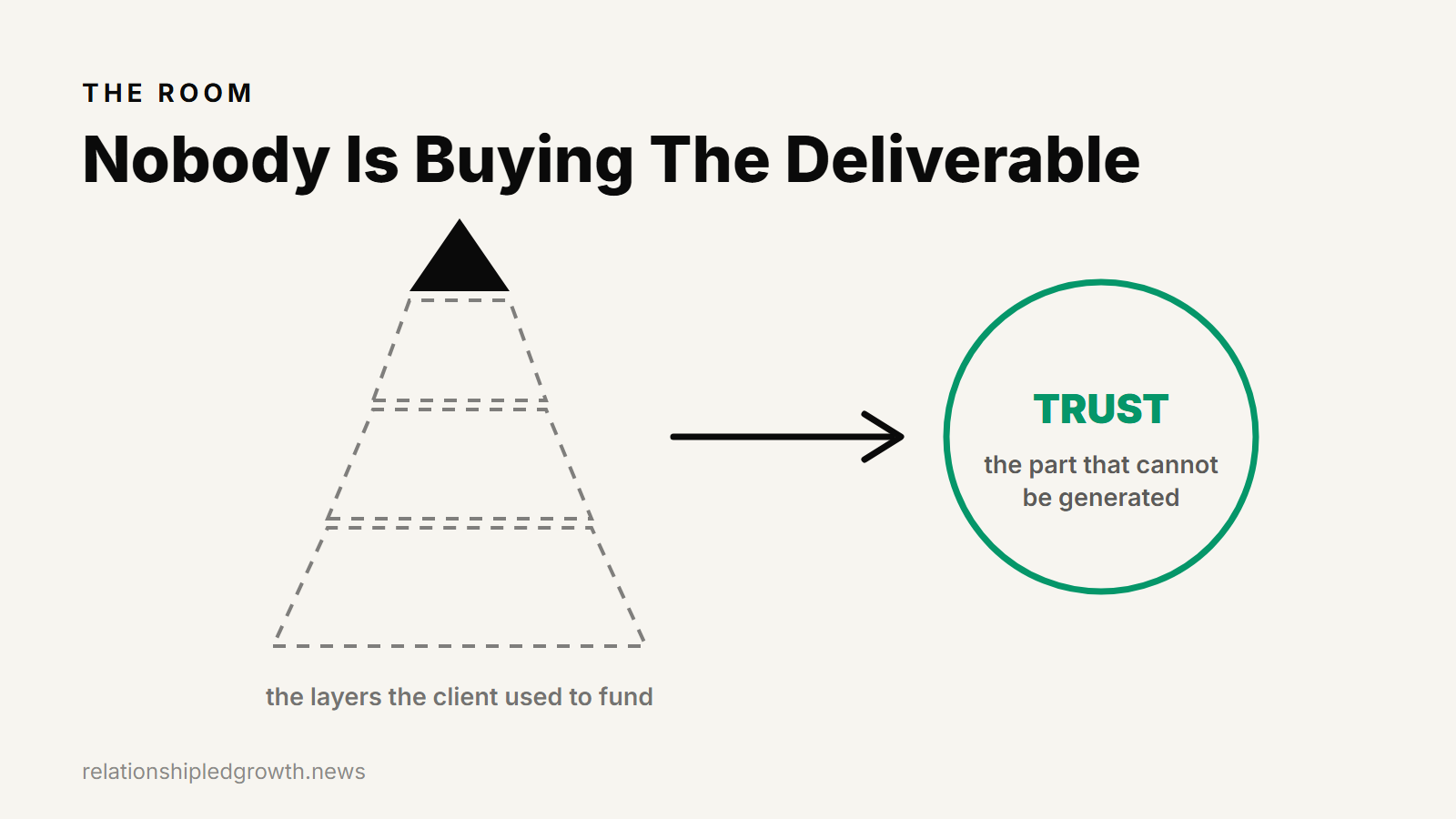
The consulting career path used to be a pyramid, and the pyramid had a job.
Hundreds of analysts produced the first cut. The data pulls, the market scans, the structured diagnostic, the slide-grade pages. A thin layer of senior people then shaped that raw material into judgement, and the client paid for the whole stack because there was no way to get the second part without funding the first.
That arrangement is coming apart, and it is coming apart from the bottom.
The first-cut work now takes minutes. Not by some future technology, but by tools the large firms are shipping to themselves right now. The hiring volumes that paid for the senior layer do not survive that, and the senior people are working it out. Which is why the flow of experienced operators leaving established firms is not really a lifestyle story. It is people arbitraging a structural cost shift, because one senior person with modern tooling now beats one senior person plus a team of juniors inside a firm with a building to pay for.
If you are an independent consultant or a fractional executive, that shift is running in your favour. You are the version of this business with no pyramid to defend.
But there is a second consequence, and it is the one I want to argue about, because most people stop at the first.
The uncomfortable half
If the artefact is cheap, then producing an excellent artefact is no longer why anyone chooses you.
That is a harder sentence than it looks, because the artefact is what most of us built an identity on. The quality of the analysis. The clarity of the deck. The rigour of the model. Decades of professional pride sit in exactly the place that just became abundant.
I do not think this means expertise stops mattering. It means expertise stops being visible as a differentiator, because the output no longer proves it. When a competent generalist with good tools can produce something that looks broadly like your work, the artefact has lost its ability to signal who is actually any good.
So the buyer has to choose on something else. And whatever that something else is, it is now the entire basis of competition.
If you want to follow this argument as it develops, subscribe. Two essays a week, and the interview series lands here first.
What I think is replacing it
My honest answer is that I do not fully know, and that is precisely why I am about to spend a lot of time asking.
I have a hypothesis. I think buyers are shifting weight onto the things AI cannot produce. Whether you understood their situation before you were briefed on it. Whether your judgement has been right before, for them specifically. Whether you can be trusted with something politically difficult. Whether you will still be there in eighteen months.
In other words, relationship and track record, which were always part of the decision, becoming most of it by default as everything else levels out.
If that is right, the implication for an independent practice is significant and slightly counterintuitive. The correct response to work becoming cheap to produce is not to produce more of it faster. It is to invest in the layer that decides who gets asked in the first place, which is almost entirely relational and almost entirely un-automatable.
But I want to be careful here, because this is exactly the kind of theory that sounds right to the person selling relationship software, and that should make you suspicious of me.

Why I am going to the other side of the table
It is consultants talking to consultants about how consulting is changing. Every panel, every newsletter, every LinkedIn thread. All of it is the selling side, theorising about the buying side.
Almost nobody is asking the people who actually sign the contracts.
So I am starting a series where I interview them. Directors and VPs inside large organisations who commission this work, about what has genuinely changed in how they buy it. Whether the deliverable still carries weight. What now makes them shortlist someone. What makes them quietly drop a supplier they used to rely on. Whether their own AI tooling has changed what they bother paying for at all.
Some of those conversations will be on the record with named guests. A lot of them will not be, because a senior buyer will not say anything useful about suppliers with their name attached, and the candid version is the version worth having. So there will be an anonymised track, and I would rather have the honest answer without the name than the diplomatic answer with it.
It is called Secrets from the Inside, and the reason I am doing it is straightforward. I have a theory about what buyers now value. I would rather test it than publish it.
If you sell consulting work, the findings will be more useful to you than another consultant's opinion. Mine included.
Two things you can do while I go and ask
If the theory holds, the practical response is not to produce faster. It is to be better at the layer that decides who gets asked, and that layer is entirely relational.
Which in practice means two unglamorous things. Knowing what every client and prospect has actually told you, so that you show up understanding their situation rather than being briefed on it. And noticing when a relationship that matters is drifting, while a single message still fixes it.
Both of those are memory problems rather than effort problems, and they are what Nynch does. It reads the relationship side of your work, holds what people said, and tells you each morning who to talk to and why now. I built it because the alternative was continuing to lose relationships I would have described as important.
But the honest position is the one I started with. I have a theory about what buyers now value, and I would rather test it than sell against it. The interviews start shortly.
If you commission consulting work and would talk to me, on the record or not, reply to this email. If you sell it, the findings will land here first.
The free field manual. 7 Playbooks To Build Your Pipeline is the complete method for predictable revenue without feast or famine. Get it free from the Nynch Growth Agent:

Read next: AI Is Making You Faster at the Work and Quieter With the People, on the trust shift this series will test, and Deep Research Is Not A Longer Search, on arriving already understanding their situation.
I write twice a week for consultants and fractional executives who grow on relationships rather than volume. Subscribe and the next one lands in your inbox.