


Every major AI tool now has a deep research mode. You give it a question, it goes away for ten or fifteen minutes, and it comes back with something long and heavily cited.
Most consultants I know have tried it, been mildly impressed, and quietly stopped using it. The output reads well and changes nothing. It tells them things they broadly knew, in more words, with references.
That is not the tool failing. That is a briefing problem, and it is the same briefing problem that produces bad work from junior researchers.
Why the output is boring
Deep research does exactly what you ask. The trouble is that most people ask it a question that has a public answer.
"What are the trends in UK manufacturing" has a public answer. So does "how is AI changing professional services" and "what are the challenges facing CFOs in 2026". These are encyclopedia questions, and you will get an encyclopedia back, which is useless to you because your client can get the same thing in ninety seconds.
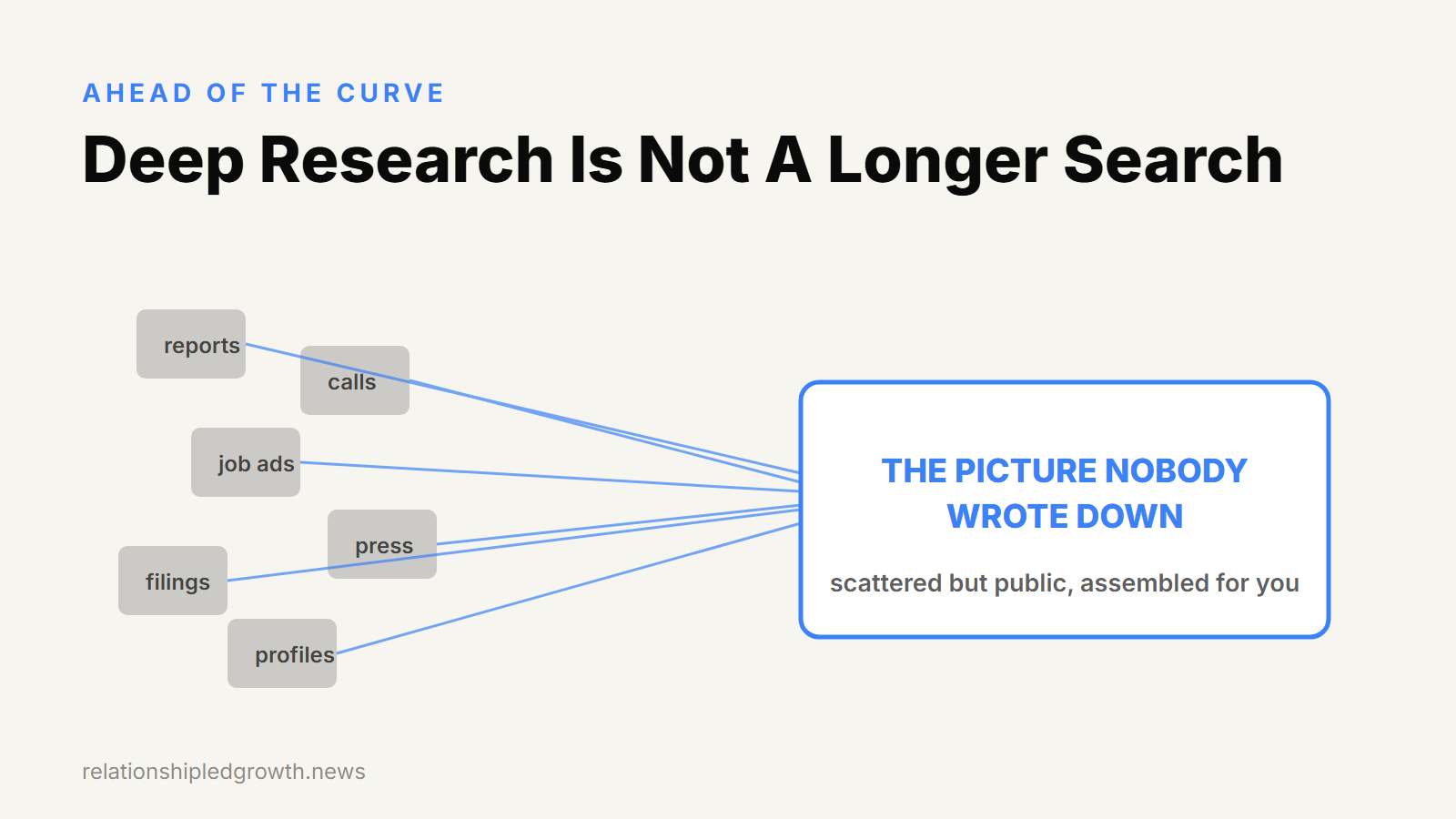
The questions worth asking are the ones where the answer exists but is scattered, and where assembling it is the entire value. Nobody has written the answer down, but the pieces are all public. That gap between scattered and assembled is where a consultant's edge now lives, because it is the one form of research that stays expensive in human time and has become cheap in machine time.
Four briefs that produce something you can use
The account dossier. Not "tell me about this company". Instead: everything this specific organisation has said publicly in eighteen months, across annual reports, earnings calls, job adverts, planning applications, regulatory filings, executive LinkedIn activity and local press. Then a specific instruction. Identify the three operational problems they have described but not named as problems.
That last clause is what makes it worth reading. Organisations announce their pain indirectly, in hiring patterns and phrasing changes, and assembling that picture across sources used to take a day.
The role-change sweep. For a named list of companies, find everyone who has moved into a relevant leadership role in the last six months, what they did before, and what they publicly said they were brought in to change. New executives buy differently from established ones. They have a mandate, a budget and a very short window in which to look decisive, and almost nobody is tracking who just entered that window.
The language audit. Take how your buyers actually describe their problem, in their own words, from forums, conference abstracts, job specifications and podcast transcripts. Then compare it to how you describe what you do. The gap is usually humbling and immediately fixes your website.
The disconfirming brief. This one is the most valuable and the least used.
Here is my view: [state it plainly]. Find the strongest available evidence that I am wrong. Do not balance it. I want the best case against me, with sources.
Everything else on this list finds support. This one finds the flaw before a client does. It is also the only prompt in my experience that reliably surprises me.
If you have already stolen one of these briefs, subscribe. Two essays a week, most of them this practical.

The rules that make it work
Constrain the sources. An unconstrained brief drifts to whatever is most written about, which is the generic material you did not want. Name the source types you consider legitimate and, where you can, the ones you do not.
Ask for the shape of the answer, not just the question. A table with named columns produces a usable artefact. An open question produces an essay. Say how many rows, what each column contains, and what belongs in a footnote.
Demand the quote. Every claim carries the sentence it came from and a link. This is not politeness, it is the only defence against a confident invention, and these tools do invent. Anything that cannot produce a source gets deleted rather than softened.
Run it against yourself first. Before you point it at a client, point it at your own business. It is a very effective way of discovering how much of what you believe about your own market is a memory from four years ago.
The mistake worth avoiding
The temptation, once this works, is to put the output in front of the client.
Do not. A twenty-page researched document delivered to a buyer signals the one thing you now need to avoid signalling, which is that your contribution is production. They can generate that document themselves, probably by the end of the year if not already.
The research is for you. It is what lets you walk into a conversation already knowing that they have been advertising for the same role three times in eight months, and ask about it. What the client experiences is that you understood their situation before you were briefed on it, which is the single most persuasive thing that can happen in a first meeting and cannot be produced by any tool they have.
Same research. One version makes you look like a supplier of documents. The other makes you look like someone who has been paying attention.
Only one of those still commands a premium.
The bit that does not scale
Every brief above works today, and the disconfirming one in particular will earn its keep the first week.
What does not scale is that this is all pull. You get the dossier on the account you thought to research, on the day you thought to research it. The role change at a company you were not looking at goes unnoticed. The organisation that started advertising for the same position for the third time does not raise its hand.
Research you have to remember to run is research you will run about four times a year.
Nynch runs the account and signal side of this continuously across your network rather than on request. Role changes, company signals, and the things people told you directly, held and surfaced when they matter rather than when you happen to go looking. The deep-research briefs above then become what you do on the accounts it has already flagged, which is a far better use of fifteen minutes than picking a company at random.
Pull research makes you look prepared for the meeting you booked. Push research tells you which meeting to book.
Talk to the founder. 30 minutes. On your real data. Not generic slides. Book a time.
The free field manual. 7 Playbooks To Build Your Pipeline is the complete method for predictable revenue without feast or famine. Get it free from the Nynch Growth Agent:

Read next: AI Is Making You Faster at the Work and Quieter With the People, on which half of the job to point the tools at, and Your Website Says One Thing. Your Proposals Say Another, on the language audit turned on your own practice.
I write twice a week for consultants and fractional executives who grow on relationships rather than volume. Subscribe and the next one lands in your inbox.