


Almost every consultant I speak to is using AI the same way. They point it at output. Draft the proposal, tidy the email, summarise the call, write the LinkedIn post.
That is fine. It is also the least valuable thing you can do with it, and I think it is quietly making people worse at the part of the job that actually pays.
Here is the uncomfortable arithmetic. Writing a follow-up email was never the bottleneck in your business. You can write a decent follow-up in four minutes. The bottleneck was knowing that the follow-up was due, to whom, and what to say that would land. AI that writes faster solves a problem you did not have. AI that remembers solves the one you do.
The failure mode nobody talks about
There is a trap sitting inside AI adoption for independent consultants, and it is worth naming plainly.
The more efficient you get at delivery, the less time you spend in the messy, low-productivity activity that generates your next engagement. Conversations that go nowhere. Coffees with no agenda. Reading something a former client wrote and replying about it.
AI compresses delivery brilliantly. It does nothing on its own for the other half. So the natural outcome of using AI well, if you use it only for output, is a practice that is more efficient every quarter and has a colder network every quarter. Both trends are real, both are invisible month to month, and only one of them shows up in revenue eighteen months later.
The fix is not to use less AI. It is to point it at memory rather than production.
What to give it
The single highest-value thing you can do is stop treating your interaction history as archive and start treating it as input.
You already have years of it. Emails, call notes, meeting transcripts, LinkedIn messages, proposals. Almost all of it is sitting somewhere searchable and almost none of it is being read by anything that could act on it.
Start with one quarter of one channel. Export it, drop it in, and ask questions you would never have the patience to answer manually.
Five prompts that earn their keep
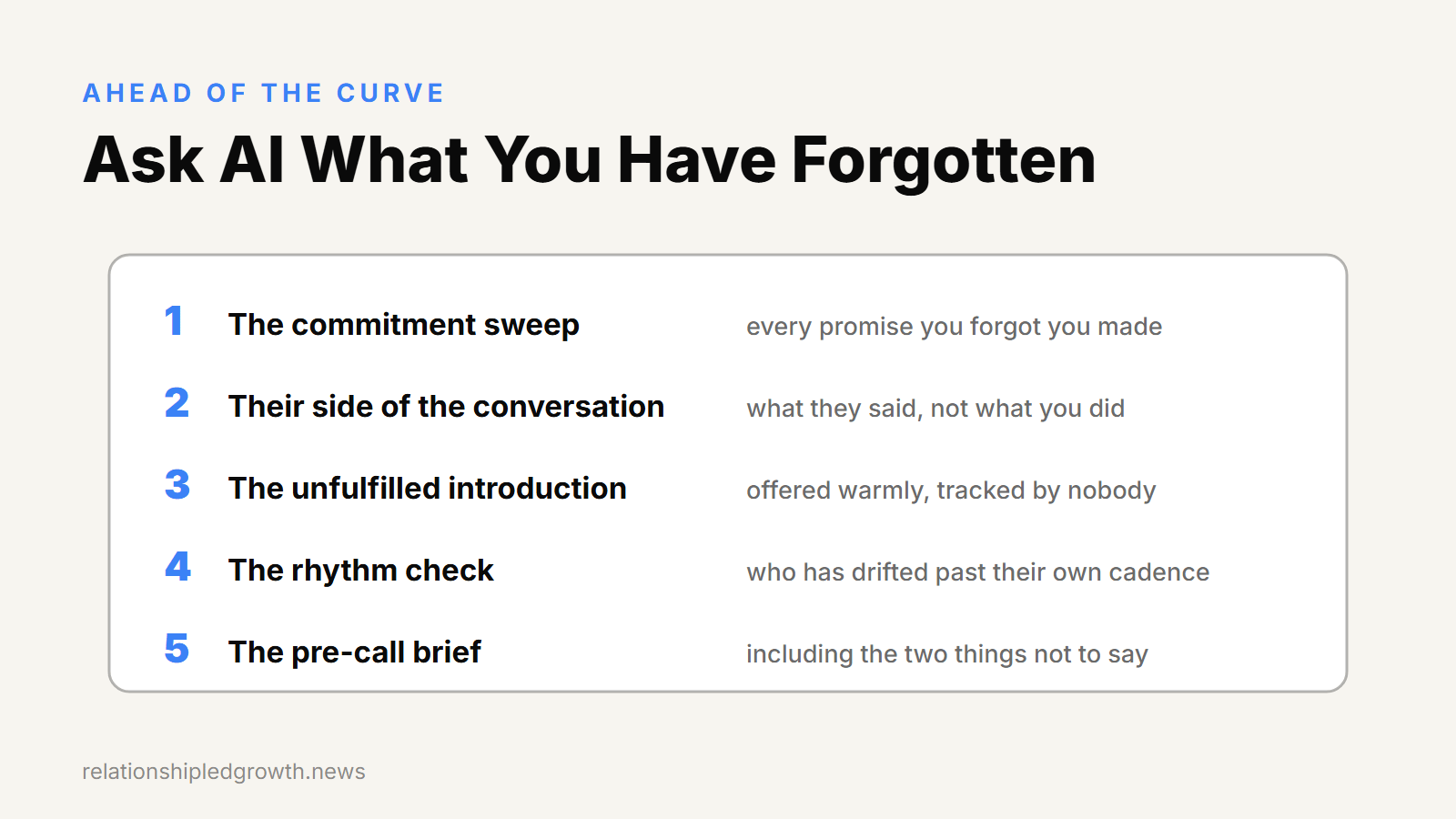
1. The commitment sweep.
Read these call notes and emails from the last ninety days. List every commitment I made and have not visibly completed. For each one, quote the sentence where I made it, name who I made it to, and say how long it has been outstanding. Ignore anything I clearly closed out later in the thread.
This is the one that stings. Most people running it for the first time find between six and fifteen open promises they had genuinely forgotten. Every one of them is a small trust debt with someone who remembers.
2. The other side of the conversation.
Go through these transcripts and pull out everything the client or prospect said about their own timing, budget cycles, internal politics, or future plans. I do not want my action items. I want theirs. Quote them directly and date each one.
Your notes are full of what you were going to do. The valuable material is what they told you about their world. Someone saying "we always have leftover budget at year end" in October is worth more than anything you wrote down that day, and it is sitting in a transcript nobody will ever open again.
3. The unfulfilled introduction.
Find every instance in these threads where someone offered to introduce me to a person or company, or where I offered to introduce them. Tell me whether the introduction appears to have happened.
Warm introductions offered and never followed up are the cheapest revenue in any consulting business, and they evaporate almost immediately because nobody is tracking the offer.
If you are planning to run one of these tonight, subscribe first. Two essays a week, most of them this usable.
4. The rhythm check.
Here is a list of my contacts with the date of every interaction. For each person, calculate the median gap between interactions and the current time since we last spoke. Flag anyone whose current gap has stretched to several times their median.
This is relationship rhythm run as arithmetic rather than intuition. It takes AI about ten seconds and would take you a full day by hand, which is exactly why you have never done it.
5. The pre-call brief.
I am speaking to this person tomorrow. Here is everything we have exchanged over three years. Give me: what they care about, what they have told me about their business, what I last promised them, what has changed since we spoke, and the two things I should not say.
That last clause matters more than the rest. These tools are relentlessly agreeable unless you make them argue.

The rule that makes all of this work
Give it evidence, ask for quotes, and never accept a claim without one.
The failure mode with any of these prompts is a confident, plausible, entirely invented summary. The defence is simple and non-negotiable. Every finding has to carry the sentence it came from and the date. If it cannot quote the source, it did not happen.
Apply the same discipline to anything it drafts on the back of this. A message built on a real thing someone actually said, quoted accurately, is worth fifty personalised-at-scale messages. A message built on a hallucinated recollection of something they never said will end the relationship faster than silence would have.
Where the manual version runs out
Everything above works in a chat window today, and I would rather you run it manually first, because seeing what is actually buried in your own history is a useful shock.
The ceiling arrives fast though, and it is not about prompt quality. It is that this only ever tells you about the quarter you happened to paste in, on the day you happened to think about it. The commitments you forgot last month get found. The ones you forget next month do not, because nobody is running the sweep again.
That gap is the whole reason Nynch exists. It runs these five jobs continuously against everything connected, rather than on the days you remember to ask. The commitment sweep runs every day. The callback surfaces the week it comes due, not when you next go looking. The rhythm check covers your entire network rather than the list you pasted in. And every suggestion carries the sentence it came from, with the date, because a recommendation you cannot audit is one you will stop trusting.
Same idea as the prompts above. The difference is that it happens whether or not you are thinking about it, which is exactly when you need it most.
Either way, the shift is the same. Stop asking AI to write things. Start asking it what you have forgotten.
Talk to the founder. 30 minutes. On your real data. Not generic slides. Book a time.
The free field manual. 7 Playbooks To Build Your Pipeline is the complete method for predictable revenue without feast or famine. Get it free from the Nynch Growth Agent:

Read next: Deep Research Is Not A Longer Search, on briefing the research side properly, and AI Is Making You Faster at the Work and Quieter With the People, on why pointing AI at the wrong half quietly costs you the next five years.
I write twice a week for consultants and fractional executives who grow on relationships rather than volume. Subscribe and the next one lands in your inbox.