


There is a lie at the heart of modern business software, and it is costing the professional services industry billions a year in lost revenue, wasted time, and burned-out talent.
The lie is not
a
conspiracy. It is a deep architectural misunderstanding of how high-value, expertise-driven businesses actually grow.
For twenty years the technology industry has told independent consultants, fractional executives, boutique agency founders, and specialised advisors the same thing. To grow your revenue, act like a transactional, volume-based sales team. Buy a CRM. Build a linear pipeline. Track your leads, drag digital cards across a Kanban board, and crush your quotas.
They handed you a digital filing cabinet and told you to spend your Friday afternoons doing manual data entry.
If you are reading this, you already know something feels off. Your title is bigger than ever. Your expertise is deeper than ever. Your network is, in theory, vast. And yet you feel like you are hustling inside a structure that was never built for you.
You are caught in what we call the Better Trap. You are using legacy tools to play a game you were never meant to play, optimising a system that is hostile to the way you actually create value. No matter how good the tools get, you should not be in that game in the first place.
The data confirms the intuition, and the numbers are stark. More than 60 percent of CRM initiatives that fail on adoption or ROI fail for people-related reasons. The primary cause is low user adoption and a visceral rejection of the software by the people forced to use it.
“I love CRM,” said no one, ever. (Clari Research Report, 2022.)
Why do professionals hate these systems? Because of the invisible tax of manual labour. A 2022 report found that 72 percent of salespeople spend up to an hour a day on manual data entry and stitching records together across tools. The average rep loses five and a half hours a week to it, three of those hours simply logging calls and emails. For a volume-based junior rep, that is annoying but arguably necessary for management oversight.
For a highly paid expert, a fractional CFO charging $2,000 a day, a specialised legal consultant, a boutique agency founder, it is a catastrophic misallocation of cognitive capital.
You are not paid to log data. You are paid to solve complex problems, synthesise information, and provide strategic counsel. When a system forces you to act as a data-entry clerk, it is actively costing you money. It steals the hours you should be spending on the relationships that actually drive the business.
This is not a critique of technology. It is a critique of the wrong technology being sold to the wrong people for the wrong reasons. It is the case for Relationship-Led Growth, grounded in physics, neuroscience, and the hard economics of trust.
The origins of the Sales-Industrial Complex
To understand why your CRM is failing you, understand its history. Software is never neutral. It encodes the assumptions and business models of its creators.
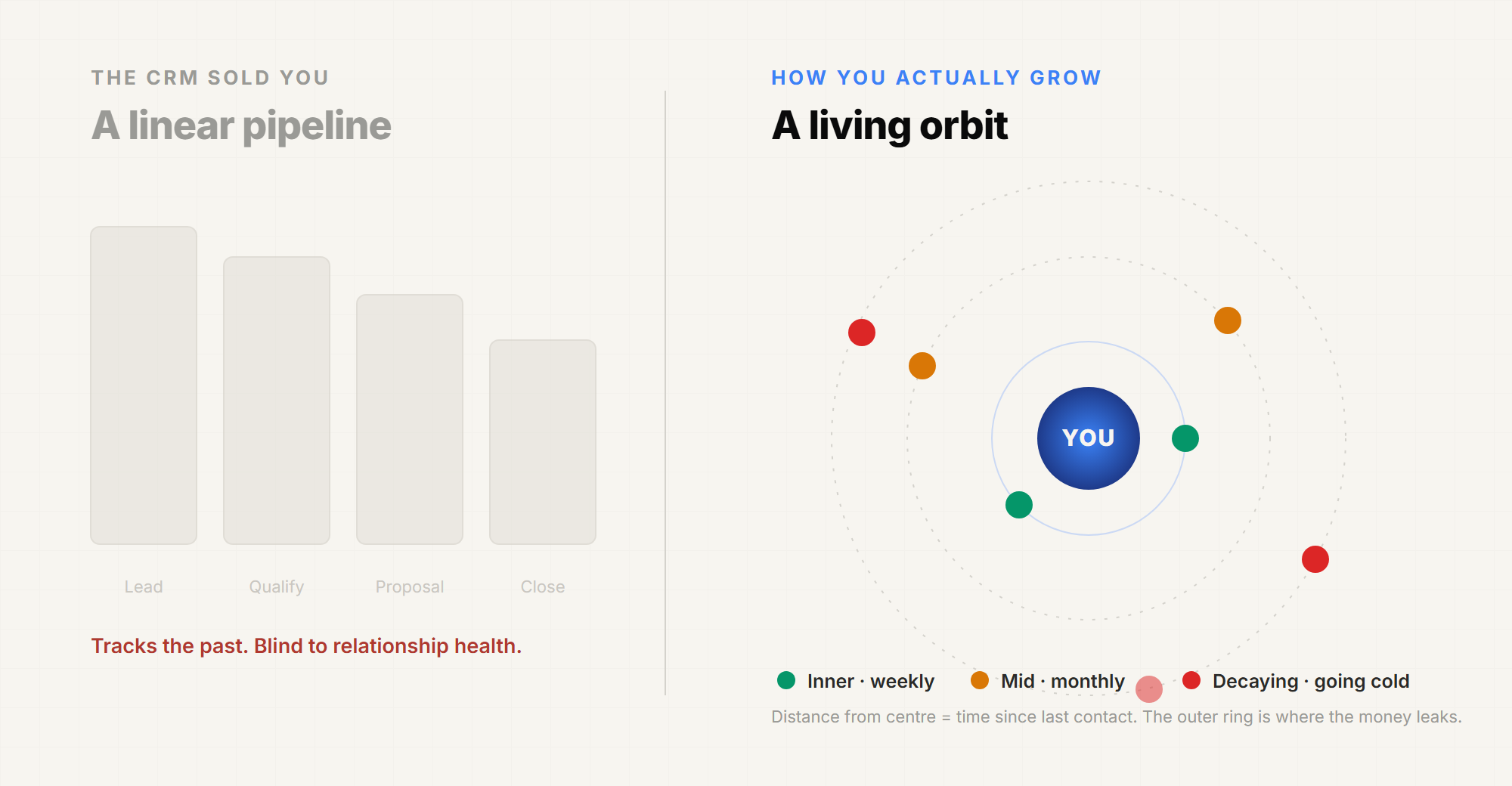
The cloud CRM was shaped by the needs of volume-based B2B sales teams. Early systems in the 1980s, like ACT!, were built to automate high-volume sales processes. The 1990s brought Sales Force Automation, and the launch of Salesforce in 1999 set the sales-centric mould. The architecture was built around one linear idea: the sales funnel. Put leads in the top, qualify them, drag them through stages, close them at the bottom.
It was a factory model applied to human interaction. That design created the Sales-Industrial Complex, a set of tools geared to the needs of sales leaders managing large, junior teams. The CRM became an instrument of micromanagement and reporting, a surveillance mechanism dressed up as a productivity tool.
Its real beneficiary was never the salesperson. It was the sales manager who needed a dashboard for the Monday morning pipeline review. Constrained by the tools they bought, those leaders spend their hours on pipeline inspections, field-by-field activity audits, deal archaeology, and dashboard hopping.
Consultants and knowledge workers do not operate this way. Their interactions are relationship-based, diagnostic, and prescriptive. A consultant does not close a relationship. They open it, maintain it, and occasionally monetise it when the client’s need aligns with their expertise.
The linear funnel is the wrong shape. The correct shape is an orbit. Force a relationship-driven business into transaction-driven software and the system breaks.
The CRM was built to track transactions. But you do not sell transactions. You sell trust. And trust cannot be dragged across a Kanban board.
The Knowledge Worker versus the Creator Capitalist
The mismatch comes from a shift in the nature of the work itself. CRMs were built for the Knowledge Worker economy. A Knowledge Worker is paid to remember things, execute reliably, and trade time for money. They live in a world that is 70 percent reactive, and a traditional CRM suits them perfectly. It hands them a list of tasks, emails to send, and data to enter.
You are not a volume-based rep. You belong to a different economic class, the Creator Capitalist, and your day is 70 percent proactive. You are not paid for how fast you answer an email or how many cold calls you make. You are paid for delivering outsized outcomes. You win because of your expertise, your reputation, and trust built over decades. Your edge is not speed. It is depth. It is not volume. It is precision.
This shift is accelerating. The pandemic triggered a reappraisal of career paths and a reflexive move away from traditional employment toward autonomy. The result is an explosion of skilled independents building micro-enterprises around their expertise.
Fractional executives are the clearest example. Senior leaders integrate into a company’s C-suite part-time, typically one to three days a week. They do not just advise. They execute and own outcomes. The model costs the business around 60 percent less than a permanent hire while handing the executive real autonomy. Demand is exploding. LinkedIn profiles mentioning fractional roles rose from 2,000 in 2022 to 110,000 in early 2024, a 5,400 percent jump.
Independent consulting is booming alongside it. The number of independent contractors earning over $100,000 a year reached 4.7 million in 2024, up from 3 million in 2020. These professionals run lean, often at 70 to 85 percent margins. They are not building large agencies. They are building highly profitable, expertise-driven micro-enterprises.
Which raises the only question that matters. How do you stand out?
For the Creator Capitalist, the greatest human alive cannot work faster than an AI. If you are manually updating a contact’s job title or typing up notes from a Zoom call, you are doing the reactive drudgery of a Knowledge Worker, and competing on the one axis where you are guaranteed to lose. You do not need to shout over the noise with 500 cold emails to capture demand someone else created. You need to use the relationships you already have to create demand, and operate at the strategic layer while the technology carries the admin.
You do not need a pipeline. You need an orbit.
That is the thinking behind Nynch, our Relationship-Led Growth platform. In place of the Kanban board, the orbital model reads the true state of every opportunity from your own data, drawing on 32 or more signals: call transcripts, sentiment, the number and seniority of the people engaged, how well the core challenge has been surfaced, how closely the client fits your Ideal Client Profile, how completely the project ROI has been mapped, and more.

The physics of orbital decay
Most experts believe that if they simply do great work, the referrals will keep coming. They treat their network as a static database. One connection made is a connection kept. Trust, once earned, is eternal.
The science says otherwise. Your network is a living system governed by strict mathematical rhythms, and to understand it you have to look past the sales literature, toward astrophysics.
In space an orbit is not a permanent state. It is a balance of gravity and velocity. Satellites in Low Earth Orbit meet atmospheric drag, and that friction slowly lowers their altitude. As altitude drops, drag rises, which accelerates the fall. The loop is called orbital decay. A satellite at 100 km decays in about 2 hours. At 500 km it takes 2 years. At 800 km it takes 200 years. The closer you sit to the atmosphere, the more friction you feel, and the faster you fall.
The same physics governs your professional network. Every connection you have, a former client, a trusted champion, a prospective CEO, has a natural communication cadence. Some sit in Low Earth Orbit at weekly contact. Others sit in Geosynchronous Orbit at annual contact. When you stop communicating, drag (time and distraction) starts pulling them down.
When the gap since your last contact passes 8.33 times your normal rhythm, the odds of that relationship surviving fall below 50 percent. If you normally speak to a client every month and you let 250 days pass, that relationship is, statistically, dead.
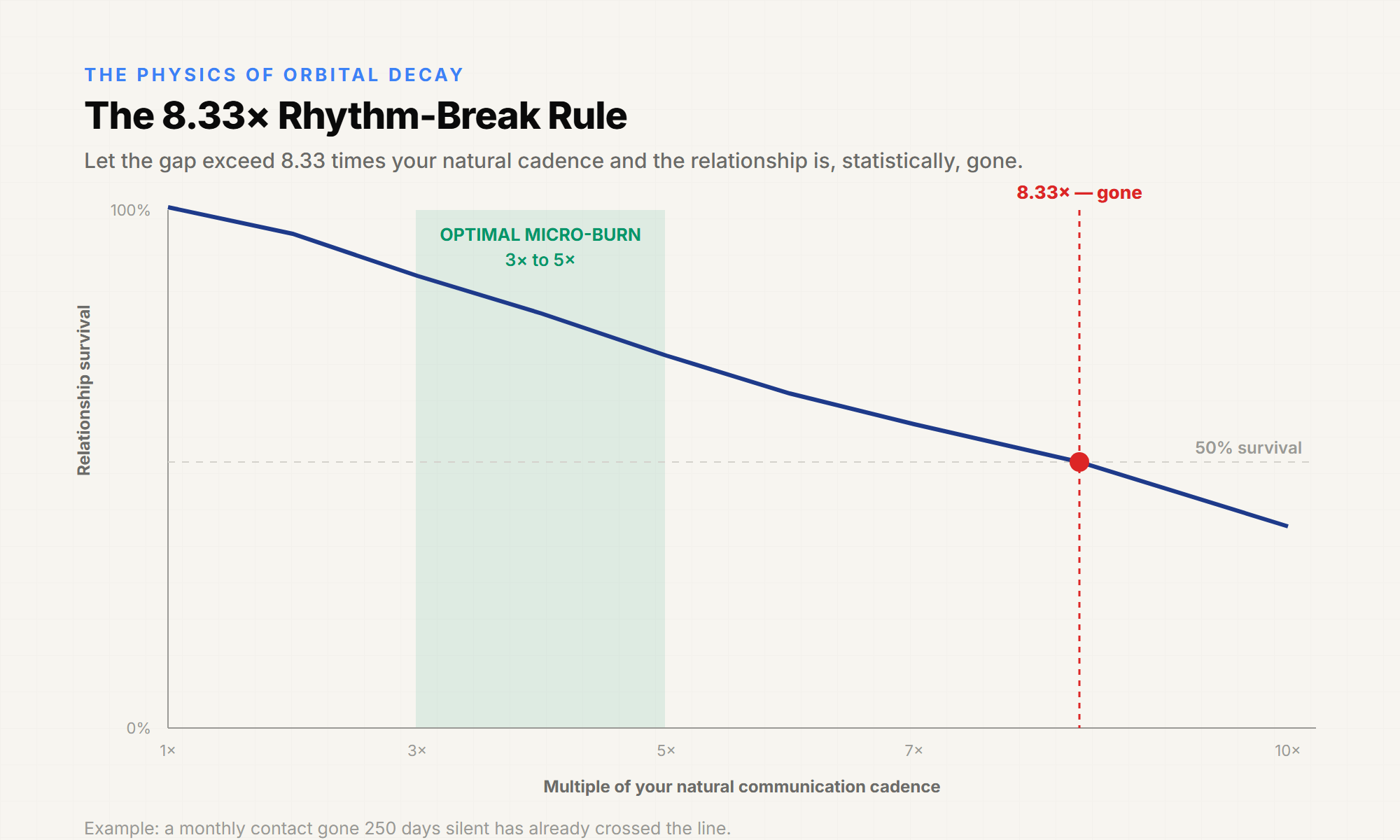
The 8.33× Rhythm-Break Rule: when a communication gap exceeds 8.33 times your natural cadence, survival probability drops below 50 percent. The optimal Micro-Burn window sits between 3× and 5× your natural rhythm.
Once a relationship hits that threshold it drifts out of your active inner circle and into the cold outer rings. They do not hate you. They have not chosen a competitor. They have simply forgotten about you. The gravitational pull of your expertise has faded, and they are now exposed to the gravity of someone who is actively in touch with them.
Traditional CRMs are blind to all of this. They will happily show you a £50,000 deal sitting in the Proposal Sent column, giving you a false sense of security. What they will not tell you is that your internal champion stopped replying 14 days ago and the CFO’s trust has gone ice cold. Because CRMs track activity rather than relationship health, they let your network fall asleep. They measure the past, not the present physics of the relationship.
The cost of a sleeping network
Why does it matter if a relationship drifts into the outer rings? Because that is exactly where the most lucrative opportunities live.
In 1973 the sociologist Mark Granovetter published “The Strength of Weak Ties,” now cited more than 79,000 times. He showed that weak ties, the connections marked by infrequent contact, are more useful than strong ties for reaching new information and new opportunities. Your strong ties share your immediate world and largely know what you know. Your weak ties are bridges into entirely different networks. When they go dormant, you lose your radar on the wider market.
A 2023 study in MIT Sloan Management Review confirmed the scale of that lost potential. During the quiet years your contacts keep evolving, gaining knowledge, changing jobs, widening their own circles. Reactivating them unlocks advice, referrals, and real opportunities that active ties cannot offer. But reviving a dormant tie is delicate. The same study, built on 71 executive interviews, found that a clumsy reconnection can sever the relationship for good.
“Unbelievable. Did you hear what he asked me? I will never talk to that guy again.”
Successful reconnections turn on mutual remembrance, a thoughtful approach to catching up, and a shared sense of the relationship’s history.
When you rely on human memory or a manual CRM, you miss the signal cascades, the small sequence of changes that happen just before an opportunity becomes obvious. A job move. A funding round. A leadership change. Those are the moments the window opens, and the first person to knock wins.
About 62 percent of professionals consider a job change every year. When a former buyer moves, they become an alumni customer. As Steve Jones, VP of Demand Generation at UserTesting, puts it:
“Your alumni customers are your lowest-hanging fruit. The key is to reach out at the right time with the right message.”
Companies that act on trigger events see conversion rates jump 400 percent against generic outreach. The first seller to reach a decision-maker after a trigger event is five times more likely to win. New executives are ten times more likely to bring in new services inside their first 90 days. If you wait for the RFP, you are already too late. The work is awarded to the trusted advisor long before the public knows there is a problem.
By failing to manage the gravity of your network, you build up Dormant Value at Risk. If you are forecasting £750,000 this year, but half of the people who need to sign those contracts are in orbital decay, you do not have a £750,000 pipeline. You have a revenue leak. You are losing money in your sleep.
Our goal with Nynch was to put all of that in front of you, simply. To do it, we had to kill another sacred cow of the CRM world. The to-do list.
Part 2, tomorrow
Part 2 finishes the picture:
The neuroscience of trust
The failure of good intentions
The Referral Gap, and why 54 percent of revenue is left on the table
The Nynch Micro-Burn
The end of the pipeline
And if you want to see how much revenue you are leaving on the table by neglecting your relationships, take the short quiz and get your score.