


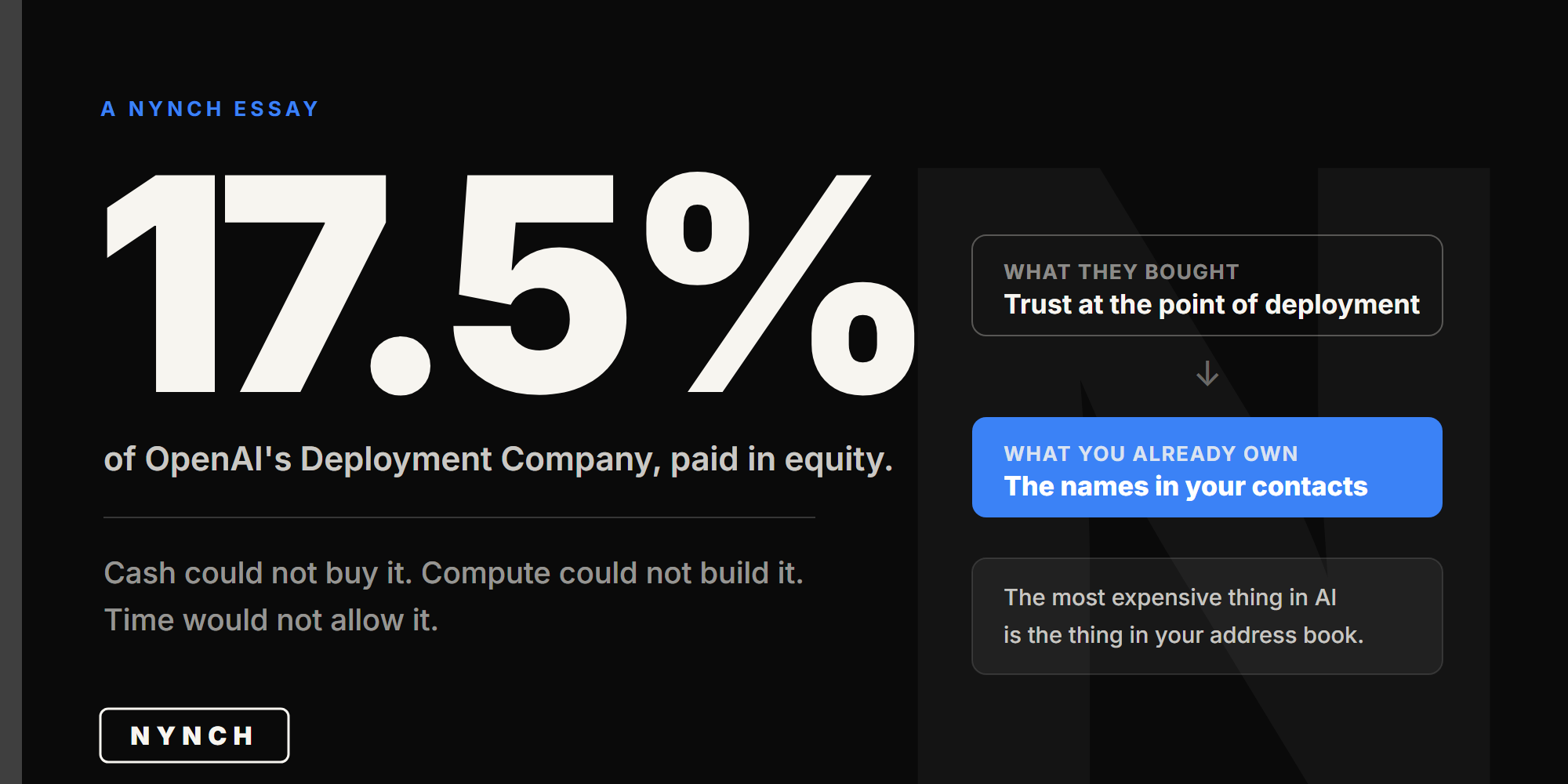
Last week OpenAI gave up 17.5 percent of its Deployment Company in equity. Not to a hyperscaler. Not to a sovereign fund. To a private-equity-led consortium with McKinsey and Capgemini sitting alongside the cheque writers. A week earlier Anthropic had announced an adjacent vehicle with Goldman and Blackstone.
The surface read is that the labs needed distribution. The deeper read is more uncomfortable. Two of the most valuable companies in technological history just published a price for something they could not manufacture in-house on any timeline that mattered. They paid in equity, because cash does not buy it.
They paid it to firms whose actual product is a partner walking into a CFO’s office and being believed.
That price tag is interesting for a reason most commentary has missed. It is not a valuation of consulting. It is a valuation of trust at the point of deployment.
And if you are a fractional CFO, a solo strategy consultant, or a fractional CMO three quarters of the way through a turnaround, the labs have just told you what your asset is worth. The only question is whether you are running it like one.
The easy answer is wrong
Most takes this week landed on the same line. The labs needed go-to-market muscle. That is the easy answer. It is not wrong, but it is not the interesting one.
Usman Sheikh’s piece in Frame Break this week, “Attention is All You Need,” named the deeper game as channel and harness lock-in. He was writing from inside the labs, looking out. This piece walks the same lens from the opposite side, looking back at what it means for the people sitting in the rooms the labs just paid to enter.
The go-to-market read is incomplete, because Microsoft and Google already had go-to-market muscle. Deeper, more enterprise-tenured muscle than any consultancy could build in a decade. The labs still paid the consultancies. What got bought was not pipeline.
What got bought
What got bought was the right to be in the room when a Fortune 500 CFO decides whether to bet a quarter of opex on a model that did not exist eighteen months ago. The right to a partner walking in, sitting down, and being believed on a question that carries real money.
That is the channel. It is not a logo. It is not a procurement code. It is one human being trusted by another, on a decision with money behind it. Without that, the model checkpoint is just a download.
Trust does not move on an IPO clock
You cannot ship trust the way you ship a model checkpoint. It compounds. It is the slowest input in the whole system, and on an IPO clock the labs hit the ceiling of what speed and capital could buy. So they bought the slow thing instead, in equity, because cash does not move it.
Sit with that. The thing that capped the most aggressive capital deployment in technological history was not compute, not data, not talent. It was the time it takes for one person to come to trust another.
The inversion
Now look at who already owns this. Solo consultants. Fractional CFOs. Fractional CMOs. Independent advisors. The boutique partner whose name is on the contract because the client picked the name, not the logo. You already hold the asset the labs just spent billions trying to install.
The most expensive thing in AI right now is not GPUs. It is the thing in your contacts list. The labs can court the handful of builders with multi-million-dollar bounties, but to sell what has been built, they need relationships.

The brittle harness
Most of you are running this valuable asset on Gmail threads, a half-updated CRM nobody opens, LinkedIn DMs that vanish into a feed, and the memory of one human brain. A frontier-grade asset on first-month tooling.
I know a fractional CFO who lost a renewal last quarter because, three weeks earlier, the CRO had mentioned a board change in a Slack message they scrolled past on a Tuesday afternoon. No system surfaced it. The CFO walked into the renewal conversation blind to the one fact that mattered, and the contract did not get renewed.
The client was not lost. The signal was lost. The relationship lost the signal because the system around the relationship was not built for the work. That is the harness problem from inside the consultancy seat. It does not matter how good the model in the chair is if the harness around it is brittle.
What a harness actually does
A harness for relationship-led work is not automation. It is not “AI for sales.” It is the thing that turns scattered signals into a proactive recommendation, and turns intent into commitment.
A Monday morning looks like this. You open your laptop. Your Superbrain has surfaced the three people in your network who went quiet and matter, ranked by why they matter and what changed, drawing on everything flowing in, from ordinary email to connected apps and data sources.
Your Authority Score has updated overnight, telling you whether the last month of your public output earned a measurable lift in inbound, or whether you spent thirty days writing into the void.
Your Unified Inbox has Gmail and LinkedIn side by side, sorted by who needs attention this week rather than who shouted loudest in the last six hours. Last week’s calls were transcribed, the commitments you made were extracted, and they are sitting on Tuesday lunchtime, waiting for you to do them or push them.
That is not a feature list. That is a Monday morning that does not start with twenty open tabs and a feeling.
Why the existing tools were not built for you
The reason most consultants run on brittle tooling is that the tooling was not built for them. HubSpot was built for marketing teams running campaigns. Salesforce was built for sales managers running reps. Both assume a large team. Both assume a funnel. Both assume the thing being managed is a pipeline of mostly anonymous strangers moving through a process.
Neither was built for the person who is also the brand, also the one who wins the work, also the delivery, also the renewal conversation, also the referral motion. The harness for that person did not exist, because for two decades that person was a rounding error in B2B software. Not any more.
From record to action
There is one heartbeat in this work that nothing in a legacy stack does, and it is the one most consultants quietly avoid. The weekly say-do review. What you committed to last week. What you actually did. And the gap between the two.
It gets avoided because nothing tracks it. Nynch tracks it. Every commitment you made in a meeting. Every promised reconnect. Every “I will send that over by Friday.” The first week of seeing the gap on a screen is uncomfortable. The next fifty are clarifying. That is the part of the harness that is hardest to ship, and the part that changes the economics of a small consultancy more than any other.
The structural close
Trust at the point of deployment is now a priced asset. The labs paid 17.5 percent of a $4B vehicle for it, because they could not build it and time would not let them. You already have it. You earned it the slow way the labs cannot replicate.
The only question is whether you are running it on Gmail and good intentions, or on a system built for the way Relationship-Led Growth actually works. When trust becomes the moat, the system around the trust stops being optional.
Nynch is being built for the person the labs are now paying to find. Not for the marketer. Not for the manager. For the consultant, the fractional, the operator who is the reason the client picked the name on the contract.
If the 17.5 percent number landed, the waitlist is open and demos are running this month.
With thanks to Usman Sheikh, whose Frame Break piece “Attention is All You Need” put the channel-and-harness lens on the table this week.