


Be honest about how many bad moments you have had in the last year.
The work dried up faster than you expected. A retainer ended. A project wrapped. The calendar that looked full in March was a ghost town by May. You told yourself you would keep the pipeline warm while you were busy delivering, and then you did not, because there are only so many hours in a day and the client in front of you always wins.
So now you are doing the thing you swore you would never do again. Opening LinkedIn. Scrolling. Wondering who to message without sounding desperate.
Most consultants and fractionals I talk to quietly admit this. And when we dig in, they have the relationships and the signals to create real conversations and real revenue. They just do not know where to look, or how to act on what is already there.
Your growth problem is not leads. It is the surfacing gap.
You think you have a lead problem. You do not. You have one constrained resource, your attention, and a brutal rule that governs it. When you are serving clients you are not finding them, and when you are finding them you are not serving. Feast funds famine. Famine panics you back into feast. The wheel turns and never lets you off.
The surfacing gap is the distance between the work you already know how to do and the people who need it today but have no way of knowing you exist.
The signal that someone needs you lives in five places that never talk to each other. The hiring intent lives on LinkedIn. The history of your past relationships lives in Gmail. The notes from your last call live in your head and a meeting recorder you never reopen. The list of who actually matters lives in a spreadsheet you have not touched in three months. And the calendar is already full of delivery. So the work that should have come to you goes to someone faster, or never gets done at all.
It was never your discipline. The signal was hidden by design.
If you have been blaming yourself for letting the pipeline lapse, stop. You were not lazy. You were doing something that is, by its structure, almost impossible to do by hand.
No amount of grit stitches those five places together every week while you are also delivering the work. That is not a willpower problem. It is a plumbing problem. The conversations that should have come to you went to someone faster, or never happened at all, not because you were not good enough, but because the thing that would surface them did not exist.
This guide is the system for closing that gap. Seven plays, each tuned to a specific shape of conversation that is already sitting there for you. Every play can be run by hand. Nynch, our AI CRM for consultants and fractionals, was built to run all seven in the background and put the prepared conversation on your desk every Monday, so you get to choose which version of the work you actually want to do.
Here they are.
Play 01. The Network Sprint (existing relationships)
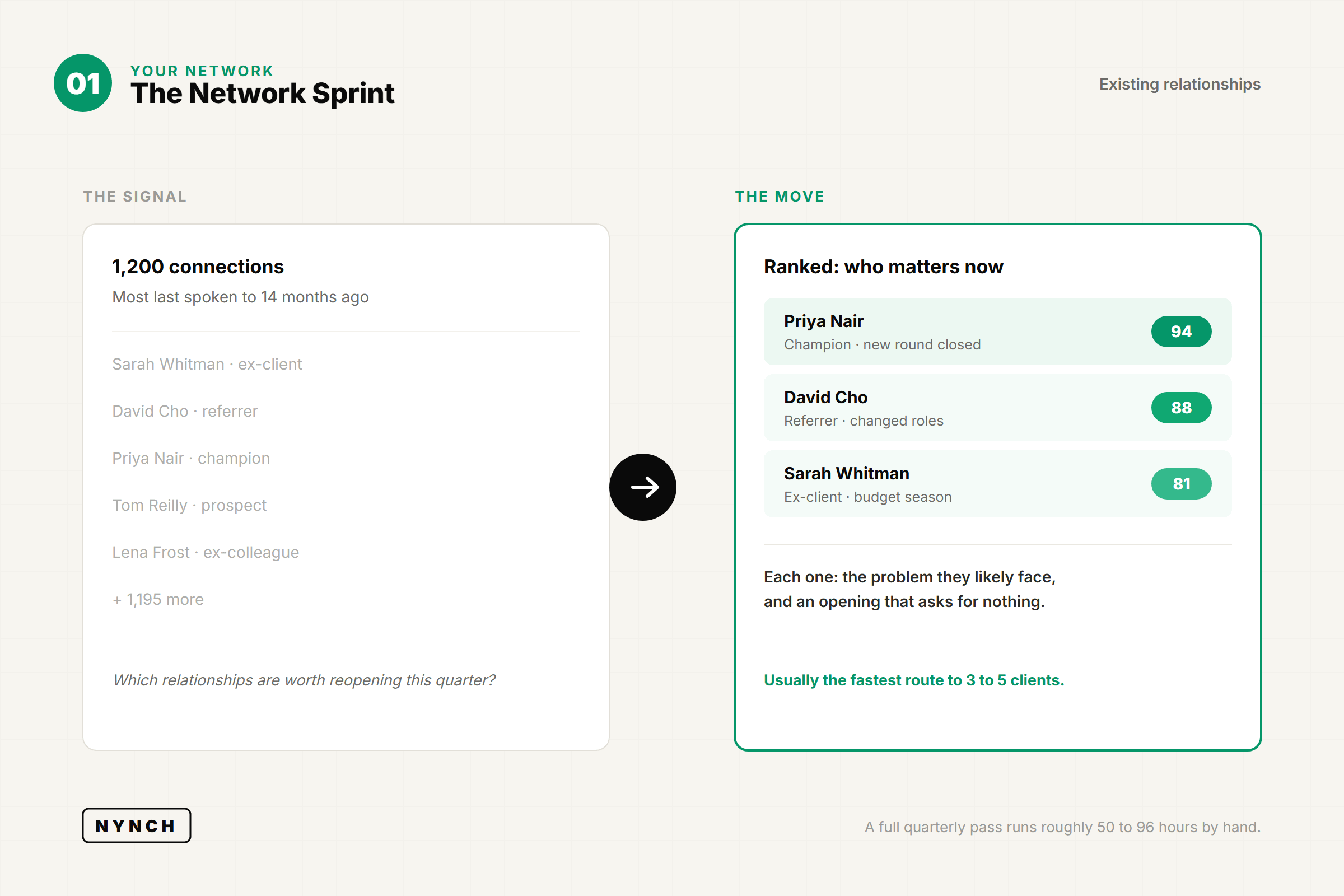
You have 1,200 people in your network. Maybe 60 of them are ready to talk this quarter. You have not spoken to most of them in over a year. This play turns the address book you already own into a live ranking of who matters now, why, and what to say.
By hand it looks like this. Export your LinkedIn connections. Define what an ideal client looks like. Score every contact for fit against that profile, then score them again for relationship strength. Predict the problem each high-fit person is probably facing. Then write a real outreach to each one that names the problem, brings a fresh angle, and asks for nothing.
That is roughly 96 hours of work for a network of 1,200. Twelve working days a year if you run it every quarter the way it needs to be run. You will do it once, and you will not do it again next quarter, because by then you are back in feast mode, head down, delivering.
Even at that cost, it is worth it. It is the foundation of what I used to call the sprint in my consulting work. It unlocks the value dormant in your network and is usually the fastest route to three to five clients. I go deeper in two earlier pieces, "Sitting On A Goldmine" and "The 5-Client Sprint."
If you have never run this process, run it. My manual process tracker is free to use. If you would rather have every contact scored by AI in the background, ordered by best fit, with a way to message them with fresh ideas, that is what Nynch does.
Play 02. Won-Deal Lookalikes (new relationships)
You won a great client last quarter. You delivered real value. And there are twenty more companies suffering from the same problem who would hire you right now, if they knew you existed. This play finds them by name.
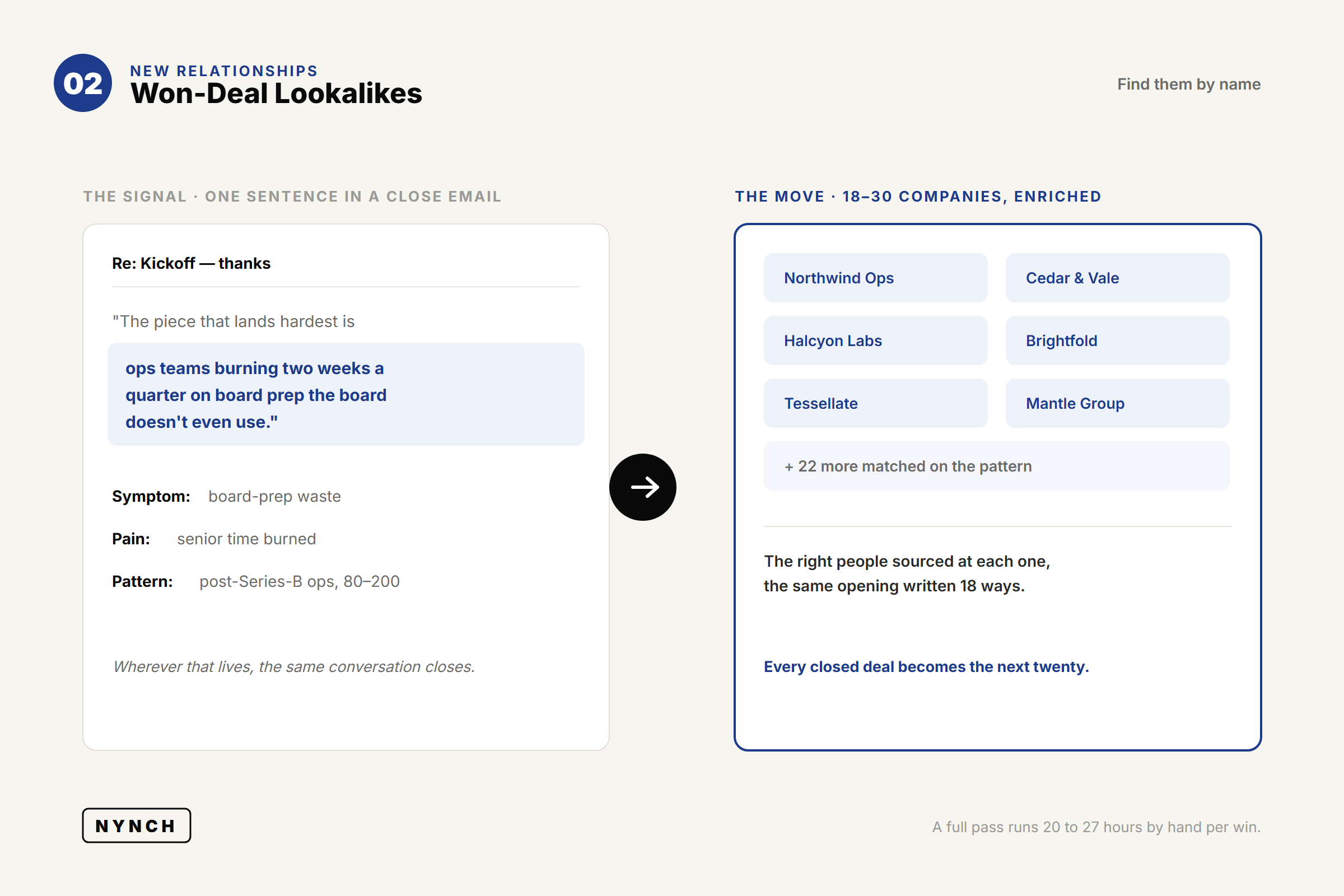
By hand. Read every email and transcript from the won deal. Distil the symptom and the pain. Look across industries to find lookalikes by shared problem rather than by vertical. Build a list of eighteen to thirty companies. Source and enrich the right people at each one. Then write the same opening eighteen different ways, using the specifics of each company.
The whole play starts with one sentence buried in a close email. When a client writes "the piece that lands hardest is ops teams burning two weeks a quarter on board prep the board does not even use, that is exactly what is happening here," that is it. Symptom: board-prep waste. Pain: senior time burned. Pattern: post-Series-B ops teams, 80 to 200 headcount. Wherever that lives, the same conversation closes.
Count it honestly. Four to six hours reading and distilling the win. Two to four building the lookalike list. Five to seven sourcing and verifying the right contacts across twenty-plus companies, the part everyone forgets. Eight to ten writing the openings. That is twenty to twenty-seven hours per win, and eighty to a hundred a year across the four wins worth running it against. Most operators do it once, on the first win, then never come back. Make it standard procedure instead. Run it by hand, or let Nynch do the heavy lifting and shorten your time to revenue.
Inside one job posting there are four different plays
A company posting a senior full-time hire is broadcasting a problem out loud. Most consultants read the headline, decide "they need a Head of Marketing," and walk straight past it. There are at least four conversations inside that same posting. One LinkedIn jobs page. Four plays. Most people run none of them.
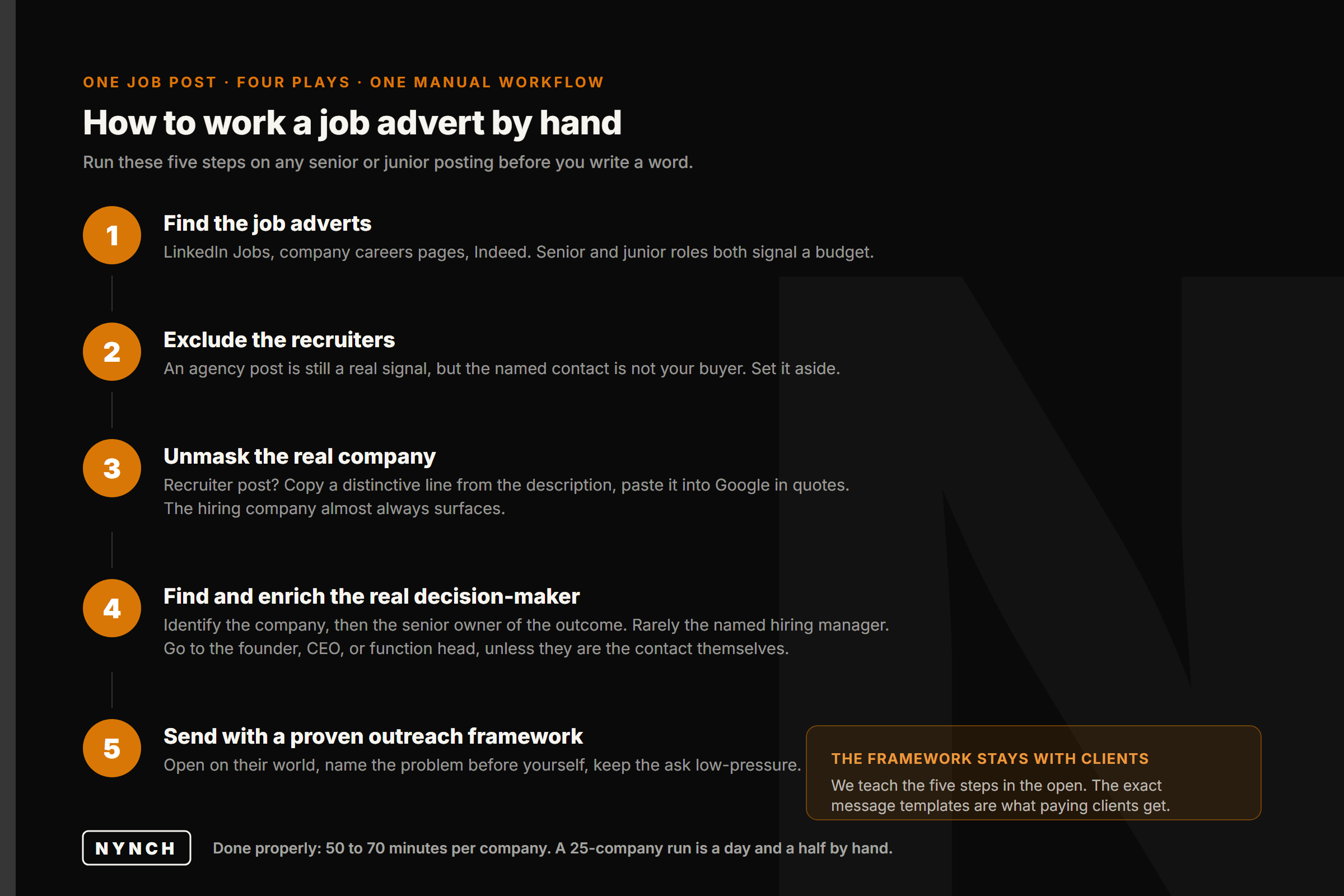
The four plays share one manual routine. Find the advert. Exclude the recruiter posts. When it is a recruiter, recover the real company by copying a distinctive line of the description into Google in quotes. Find and enrich the actual decision-maker, rarely the named hiring manager, usually the founder, CEO, or function head. Then send using a proven outreach framework. Done properly that is fifty to seventy minutes per company, so a run of twenty-five companies is the better part of two working days. The plays below are four uses of that same routine.
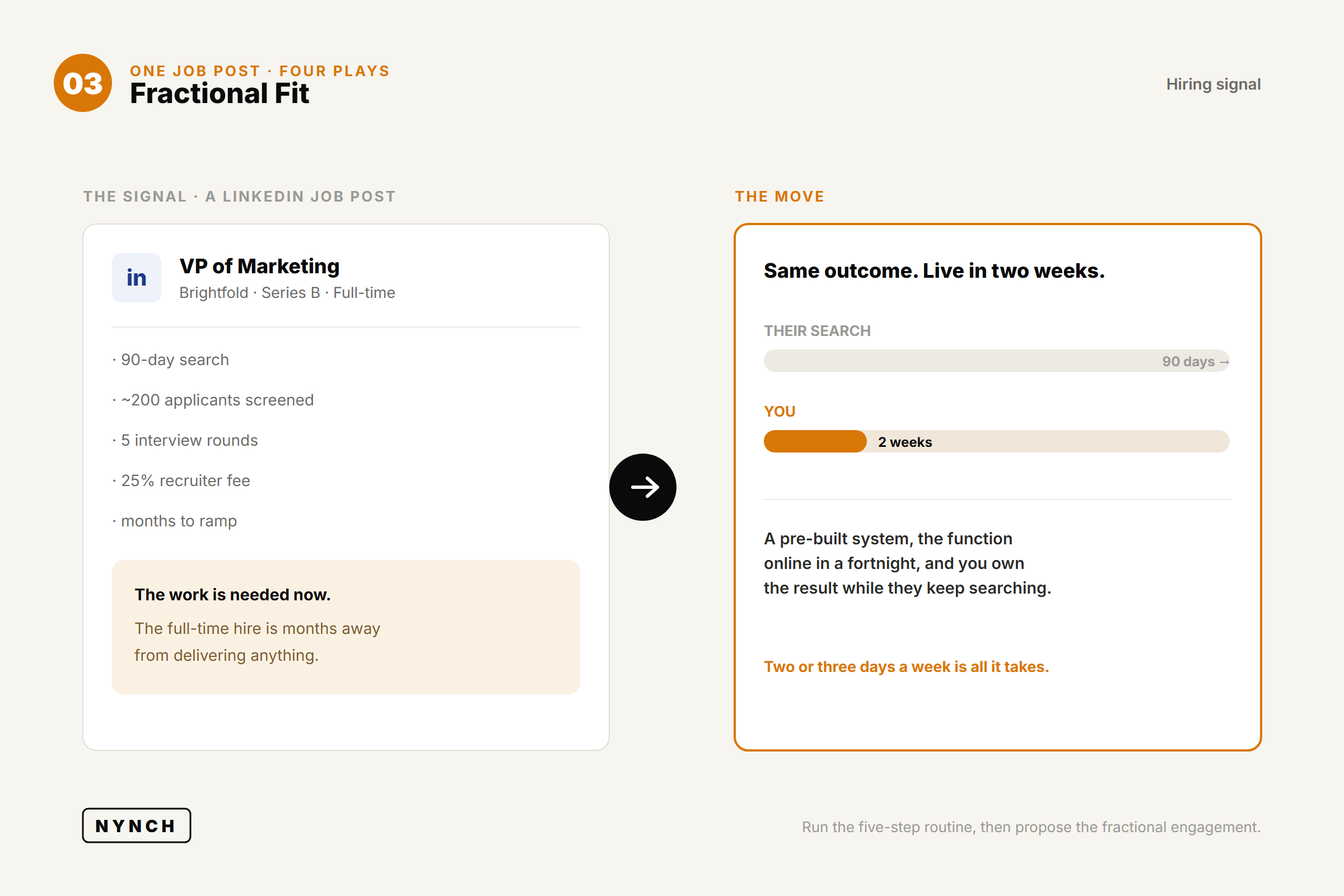
Play 03. Fractional Fit
They are hiring a full-time senior role for work you could deliver in two or three days a week. Their search takes ninety days. You can start in two, with a system already built and ownership of the result.
Look for a VP or Director-level role. They are about to spend ninety days screening 200 applicants, run five interview rounds, pay a 25 percent recruiter fee, and onboard someone who needs months to ramp. You could bring the function online in two weeks.
Talk to the founder. We are taking on founder members for Nynch, our AI CRM and growth app. We treat founder members as VIPs and hand them all of our business-development systems, plus data enrichment and one-to-one setup on Nynch.

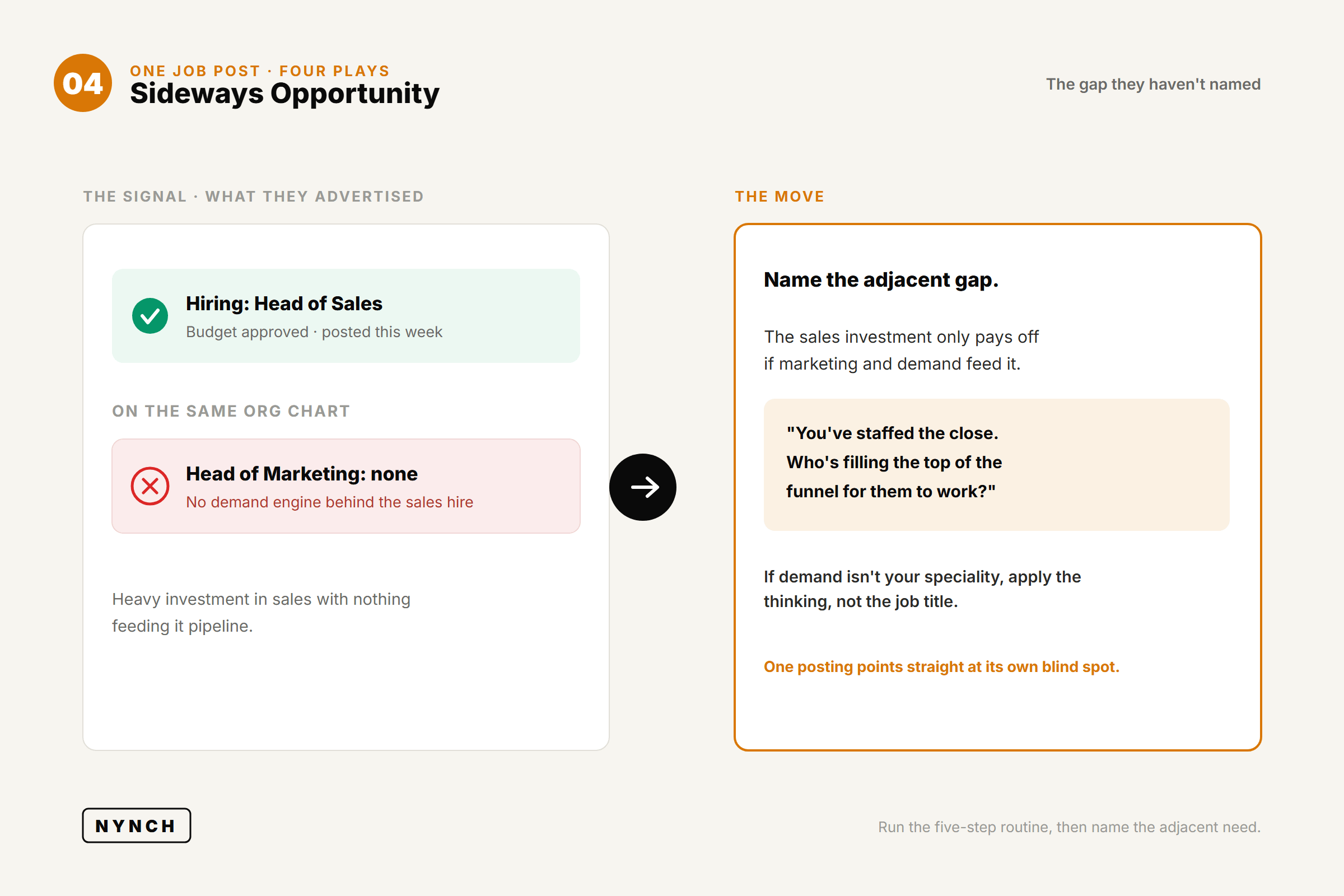
Play 04. Sideways Opportunity
They hired a Head of X. They almost certainly need a Head of Y too. They just have not named it yet.
If a growth company is hiring a Head of Sales but has no head of marketing or demand generation, there is a gap. The investment in sales can be complemented by investment in marketing and demand, which is you. If that is not your speciality, apply the way of thinking rather than the job titles.
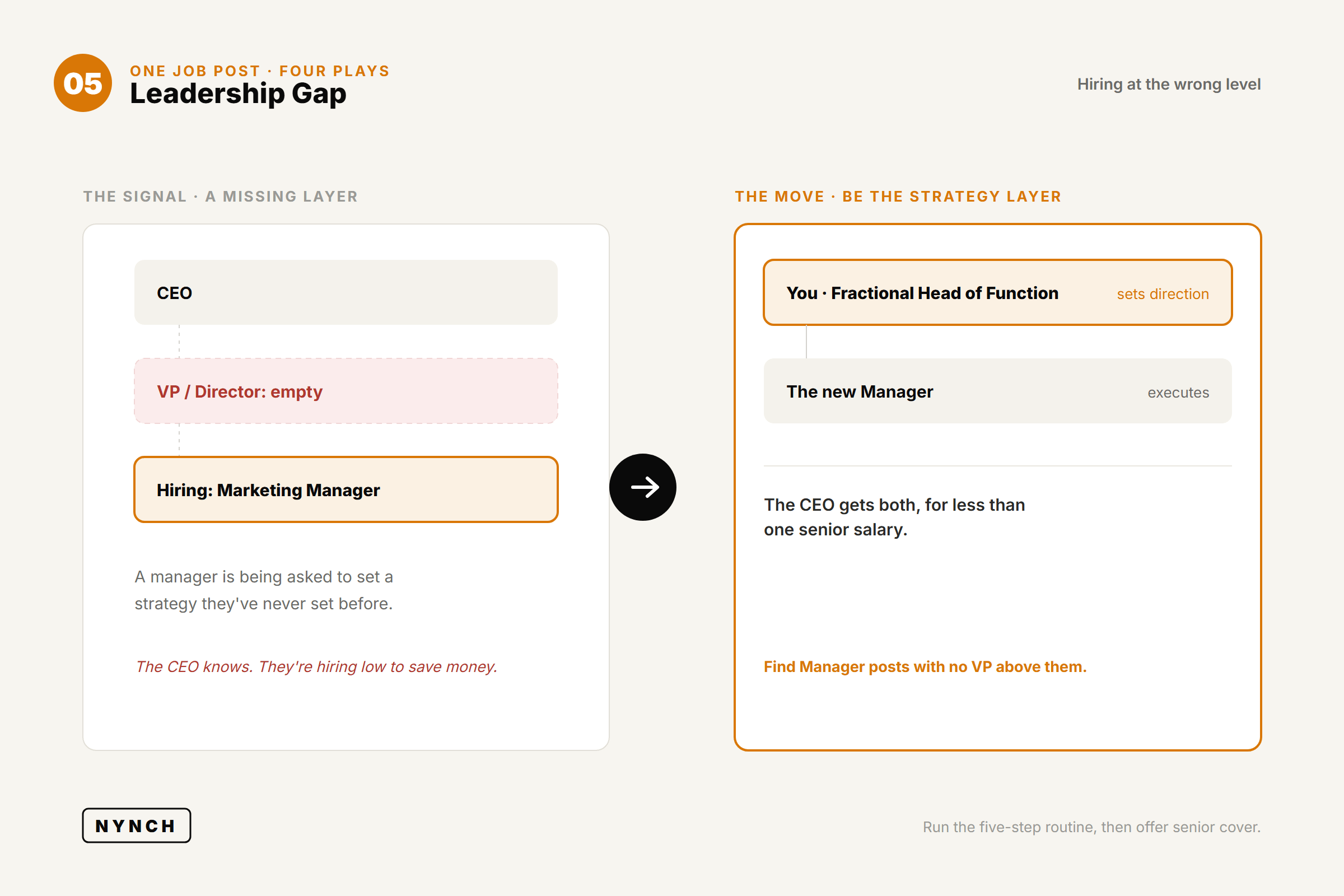
Play 05. Leadership Gap
They are hiring a Manager, and there is no senior leader above them in that function. The Manager is being asked to set a strategy they have never set before. The CEO knows it. They are hiring at the wrong level to save money.
Look for a Manager-level posting with no VP, Director, or Head of that function listed at the company. They are either underspending or unaware. Position yourself as the strategy layer. A fractional Head of Function sets the direction, the new Manager executes, and the CEO gets both for less than one senior salary.
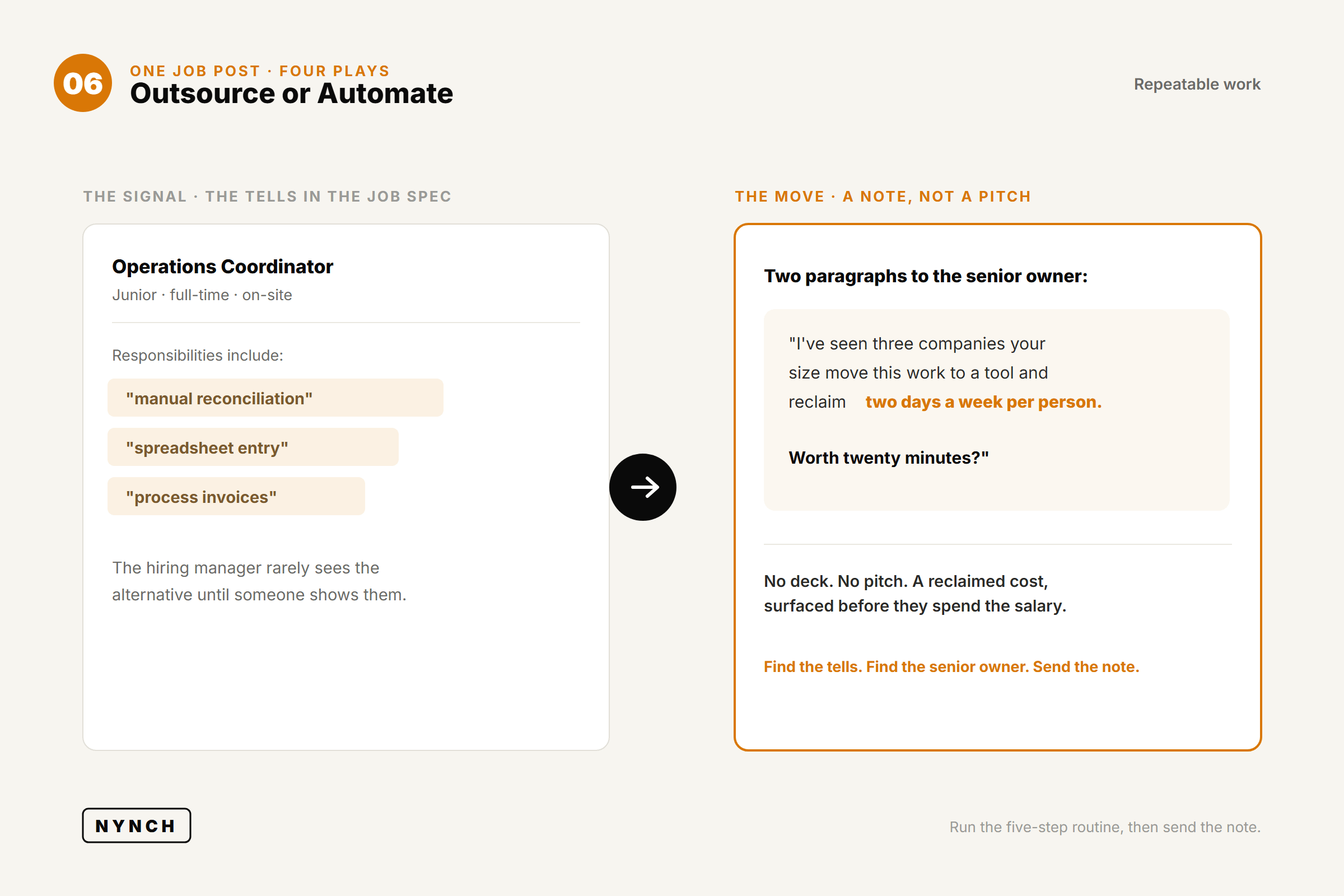
Play 06. Outsource or Automate
They are hiring junior or admin headcount for repeatable work a process, service, or tool could do for less. The hiring manager rarely sees it until someone shows them.
Look for junior data clerks, bookkeepers, scheduling coordinators. Scan the description for tells like "spreadsheet entry," "manual reconciliation," "process invoices." Find the senior person responsible. Bring the alternative as a two-paragraph note, not a pitch. "I have seen three companies your size move this work to a tool and reclaim two days a week per person. Worth twenty minutes?"
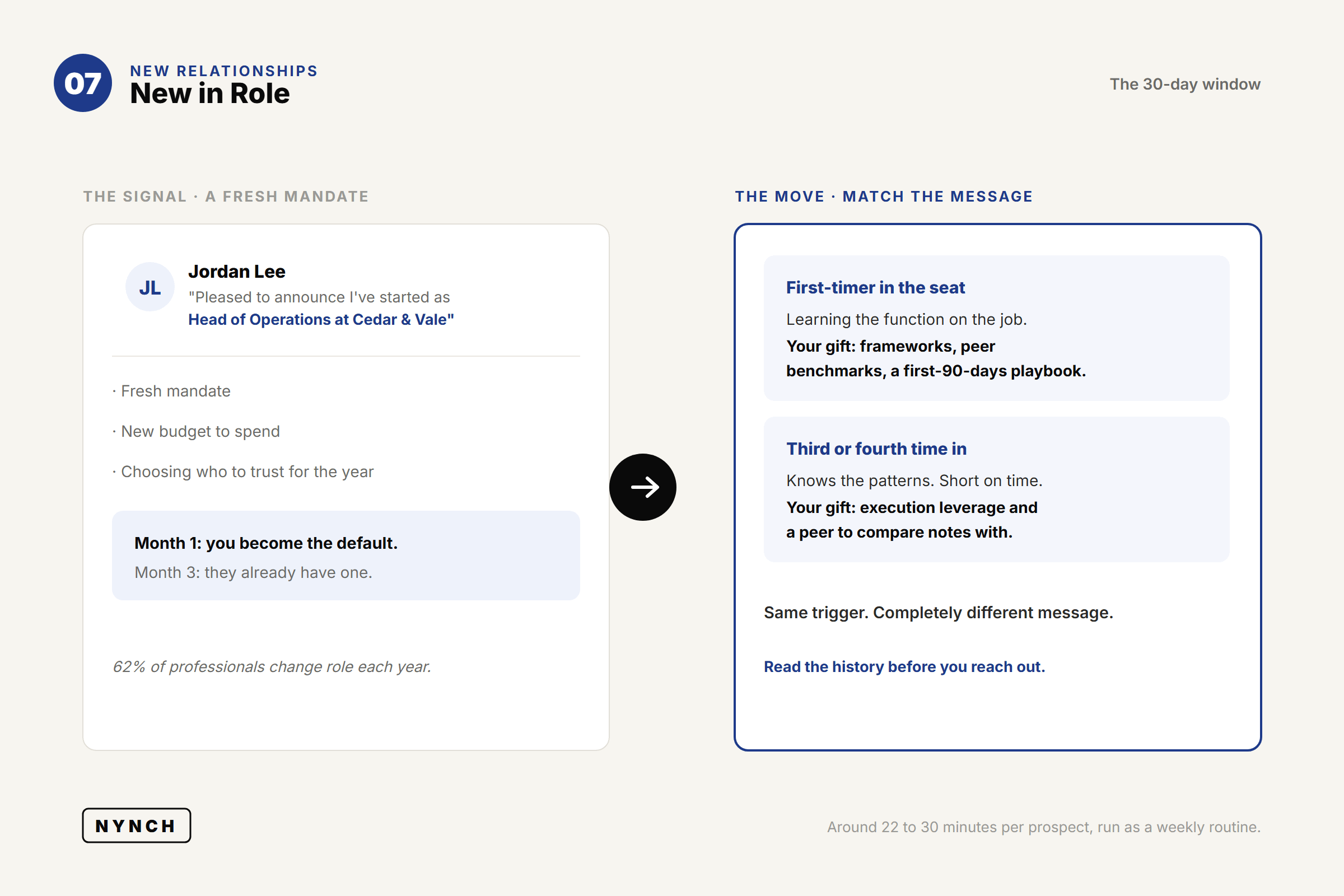
Play 07. New in Role (new relationships)
Someone just started a target role in the last thirty days. They have a fresh mandate, new budget, and are actively choosing the vendors they will trust for the year. Reach them in month one and you become the default. Reach them in month three and they already have one.
The play splits in two. A first-timer in the seat, their first Head of, VP, or Director, is learning the function on the job. They need frameworks, peer benchmarks, and someone who has walked the same first 90 days. Your offer is mentorship and a fast-track playbook. An experienced leader on their third or fourth time knows the patterns. They are short on time, not knowledge. Your offer is execution leverage and a peer to compare notes with. Completely different messages.
By hand. Watch the feed for "pleased to announce" posts, search Sales Navigator for recent role changes, verify it is a real promotion, read the full employment history to decide first-timer or veteran, match the company to your client type, find their first-month problem, and reach out with the right thing for their kind. That is twenty-two to thirty minutes per prospect, and because the window only stays open for a month it has to run every week, four to five hours of it, not once a quarter. Or become a Nynch user, because this is built in and automated.
Talk to the founder. We are taking on founder members for Nynch, our AI CRM and growth app. We treat founder members as VIPs and hand them all of our business-development systems, plus data enrichment and one-to-one setup on Nynch.
There are more plays
These seven produce the biggest immediate impact for solo and fractional operators, but they are nowhere near the full set. There are more inside Nynch, including "Who's Merging," which covers post-acquisition integration, pre-merger due diligence, carve-out and divestiture leadership, and management-buyout advisory. Each opens a different door in a market tilting more strategic every quarter. There are plays for dormant accounts you are quietly about to lose, for referrers who have gone unusually quiet, for the moment a client's biggest competitor closes a funding round, and for the conversation patterns that signal a live deal is about to ghost.
The point of this guide is not that you should run all of them yourself. That is what a system is for. The point is that the conversations are already there, waiting for someone to surface them.
If all you did was pick one of these seven and run it consistently for a year, your pipeline would look like a different business by this time next year.
The compound is what changes the business
Any single play puts real meetings on your calendar. The shift happens when several run together, because each one catches a different shape of conversation in a different week.
Network Sprint keeps you present with the people who already trust you. Won-Deal Lookalikes turns every closed engagement into the next twenty. The four hiring plays catch the moment a company has approved a budget and signalled intent in public, before anyone else turns up to compete. New in Role catches the brand-new buyer in the narrow window when they are still choosing who to trust for the year.
Seven shapes of conversation. Each one a reason to talk to a specific person in a specific week. None of them clever. All of them genuinely working.
Most consultants and fractionals do not run even one, usually for two reasons. They have no idea the plays exist, and you no longer have that excuse. Or they have no time, and Nynch does this for you and saves hundreds of hours a year, so that excuse is gone too.
Where to start
Every play here is something you can start today. Where you start depends on what you have.
If you have years of relationships gone cold, start with the Network Sprint. The data is already in your LinkedIn account and the work is mostly remembering. If your network feels thin, and that is the thing keeping you up at night, start with one of the hiring plays instead. The budget is already approved, the need is public, and the buyer is a stranger you are genuinely allowed to help.
Either way you will get further by hand than you think, right up until the time it takes catches up with you and the spreadsheet quietly stops being maintained. You know it will. It always has.
The alternative is to let Nynch run all the plumbing in the background and put your hours into the conversations themselves. That is the part nobody else can do for you. Both approaches genuinely work. Only one of them survives the next busy quarter.
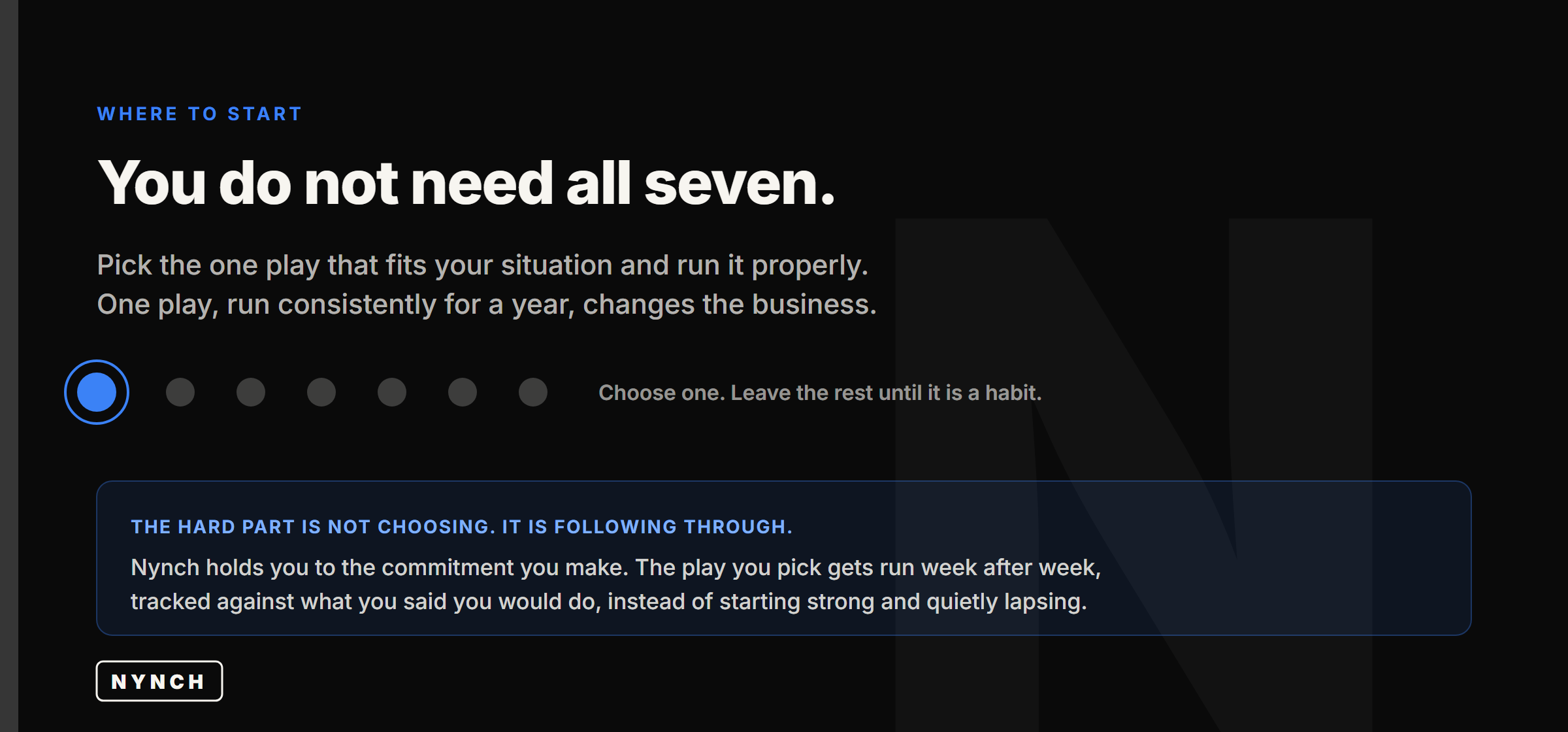
Whichever route you take, choose one play, not seven. The discipline is the hard part, not the choice. So the real job of a system here is to hold you to the commitment you made and keep that one play running week after week, tracked against what you said you would do, rather than letting it start strong and quietly lapse the moment delivery gets busy.
The pipeline you need next quarter is already sitting in front of you right now. The only real question is whether you are looking at it.
Talk to the founder. We are taking on founder members for Nynch, our AI CRM and growth app. We treat founder members as VIPs and hand them all of our business-development systems, plus data enrichment and one-to-one setup on Nynch.